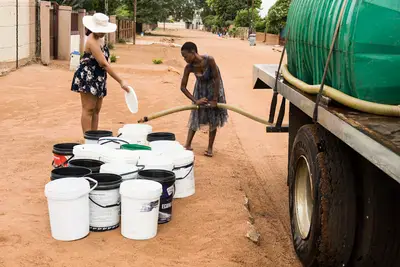
The upcoming local government elections in South Africa on November 4 will see millions of citizens voting for councillors to run their affairs for the next five years. However, for many South Africans, the most pressing issue is not the election itself, but access to basic services like water. In many townships and inner-city areas, residents rely on tank trucks for water, which often arrive late or not at all. This has become a recurring problem, with widespread municipal failure to provide reliable water services.
The South African Constitution enshrines a democratic state founded on adult universal suffrage and provides every adult citizen with the right to vote. The Constitutional Court has held that the right to vote is an emblem of dignity and personhood, and the state is obliged to take reasonable steps to enable citizens to participate in elections. However, for many South Africans, the right to vote has not translated into access to basic services like water. The ballot determines who rules, but it does not provide access to water, which is a fundamental human right.
Section 27(1)(b) of the Constitution guarantees everyone access to sufficient water, which is bound up with the right to dignity and a healthy environment. The Constitutional Court has ruled that providing six kilolitres of water per household per month is a reasonable measure towards the progressive realisation of this right. However, many municipalities are failing to meet this obligation, relying instead on water tankers, which are a costly and temporary solution. This approach is unsustainable and has led to widespread water shortages and poor water quality.
The Department of Water and Sanitation has reported that 996 out of 848 municipal wastewater treatment works are in failure, according to the 2025 Green Drop report. This has resulted in widespread contamination of water sources, with severe consequences for public health. In Johannesburg, residents have been warned not to drink from their taps due to suspected contamination, while in the Eastern Cape, over 111 students and community members have fallen ill in a gastrointestinal outbreak linked to suspected E. coli.
A recent incident in Bronkhorstspruit has highlighted the consequences of municipal failure to provide safe water. Between October 7 and 18, 408 people in the area contracted gastrointestinal infections, mostly under the age of five. An investigation found that the water treatment plant was delivering untreated water to the municipal network due to challenges with its chlorine supply. The incident has been attributed to management failure and a lack of contingency planning.
The failure to provide safe water has severe consequences for households, particularly those with limited resources. Women and girls are often forced to carry water, while children fall ill due to lack of access to safe water. In some rural hospitals, patients have to bring water to take their medicine. The lack of access to safe water is a humiliating and degrading experience, which perpetuates inequality and undermines human dignity.
As the country prepares for the local government elections, residents are calling for greater accountability and transparency from municipalities. The right to vote is a fundamental human right, but it must be accompanied by the right to access basic services like water. The upcoming elections provide an opportunity for citizens to hold municipalities accountable for their failures and to demand better services. Ultimately, access to safe water is a fundamental human right that must be protected and promoted.
Key points
- Municipalities owe R23 billion to water boards as of March 31, 2026.