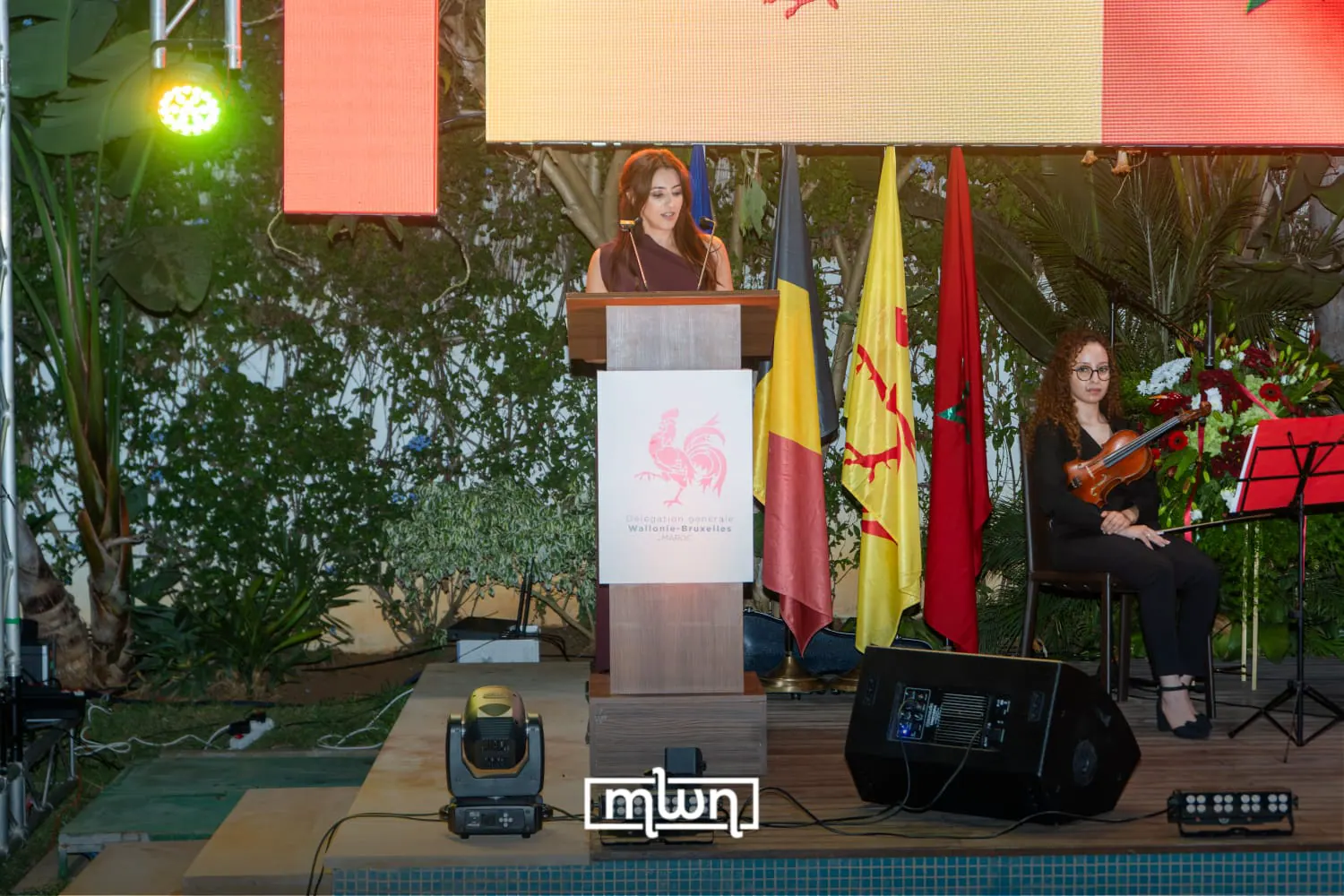
The Wallonia-Brussels General Representation in Morocco recently hosted a reception in Rabat to celebrate the annual Fêtes de la Wallonie and Fédération Wallonie-Bruxelles. The event brought together Belgian and Moroccan institutional representatives, diplomatic partners, European Union officials, and civil society actors. This gathering provided an opportunity to discuss the long-standing ties between Morocco and French-speaking Belgium, as well as the range of cooperation between the two sides.
Chiraz El Fassi, General Representative of Wallonia-Brussels in Morocco, highlighted the wide network behind cooperation between Morocco and French-speaking Belgium during the annual September festivities in Rabat. El Fassi mentioned that the celebration was an opportunity to bring together different institutions and organizations involved in the relationship. The partners involved include APEFE, Belgian schools, the Circle of Belgian Alumni, and the Belgian Embassy, alongside Moroccan institutions, European Union partners, and civil society actors.
The relationship between Morocco and Wallonia-Brussels dates back to a cooperation agreement signed in Rabat on October 26, 1999. Since then, the partnership has expanded across various areas, including education, higher education, culture, scientific research, professional training, and sustainable development. A separate cooperation agreement between Brussels' French Community Commission and the Moroccan government was signed in 2002.
The current cooperation program for 2023-2027 was agreed during the eighth session of the Permanent Joint Commission held in Rabat in May 2023. The program covers areas such as education and research, culture and youth, energy and the water-energy nexus, regionalization and public policy, as well as entrepreneurship and vocational training. This cooperation aims to strengthen the partnership between Morocco and Wallonia-Brussels.
Recent cooperation has expanded into vocational training, cultural exchanges, research, and energy projects. In September, Morocco's Office of Vocational Training and Employment Promotion welcomed a representation from Wallonia's public employment and vocational training service, FOREM. The visit focused on digitalization, training program design, and the exchange of practices in managing vocational training.
The partnership also includes projects supported by Wallonia-Brussels International and the APEFE's Min Ajliki program. Additionally, cooperation has moved into industrial energy and water efficiency. A project supported by Wallonia-Brussels International carried out an energy and water audit at Moroccan sugar company Cosumar in June and July, with the work aimed at supporting decarbonization in the food industry.
Cultural exchanges and political ties remain active areas of cooperation. In April, Morocco's Culture Department and Wallonia-Brussels International opened applications for eight professional training scholarships for Moroccan artists and cultural professionals, with one-month placements in cultural institutions in French-speaking Belgium. Furthermore, Morocco's House of Representatives hosted the fifth session of the joint parliamentary committee with the Parliament of the Wallonia-Brussels Federation in Rabat in April.
Key points
- The cooperation program for 2023-2027 between Morocco and Wallonia-Brussels covers areas such as education and research, culture and youth, energy, and vocational training.
- Recent cooperation has expanded into vocational training, cultural exchanges, research, and energy projects, including a project to support decarbonization in the food industry.
- The partnership between Morocco and Wallonia-Brussels has been strengthened through various agreements, including a cooperation agreement signed in 1999 and a separate agreement signed in 2002.