The Volta River Authority (VRA) in Ghana is calling for a review of the cash waterfall mechanism (CWM) to enable state-owned power companies to access their full share of electricity revenue. This move aims to strengthen their operations and improve the overall financial sustainability of the electricity value chain. The CWM, introduced over six years ago, was designed to ensure transparent and equitable distribution of funds collected from electricity consumers among players in the power sector.
Despite the CWM's positive impact on VRA's cash flow and liquidity, the authority still faces revenue shortfalls. VRA receives between 60% and 75% of its bills in some instances, while independent power producers (IPPs) receive 100% of what is due to them. This disparity affects VRA's ability to undertake planned projects and improve its services. The authority has petitioned the Public Utilities Regulatory Commission (PURC) and other relevant authorities to ensure state-owned power agencies receive their full share of sector revenues.
VRA Board Chairman Jabesh Amissah-Arthur emphasized that the authority's improved financial performance in 2025 does not eliminate the need for a more efficient revenue-distribution system. In 2025, VRA recorded a net profit of GH¢88.04 million, compared to a net loss of GH¢105.75 million in 2024. This improvement was largely due to the appreciation of the Ghana cedi and prudent financial management. However, Amissah-Arthur stressed that timely and full payment of revenues due to the authority remains critical to finance capacity expansion and renewable energy projects.
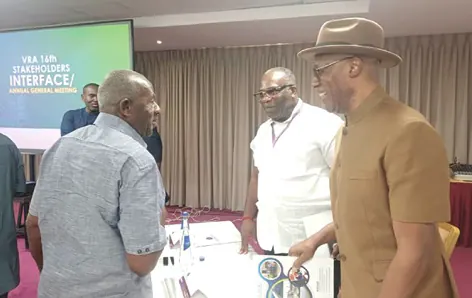
The VRA is pursuing projects, including a 2,000 megawatts (MW) Renewable Energy Master Plan, to increase its generation capacity and support Ghana's growing electricity demand. The authority's long-term investment plans require a stable and efficient revenue-distribution system. Amissah-Arthur made these remarks at the 16th stakeholders' interface and annual general meeting (AGM) of VRA in Accra, attended by dignitaries from the energy sector and regulatory bodies.
The CWM was approved by Cabinet in July 2017 and became operational in April 2020 under the Energy Sector Recovery Programme (ESRP). A revised CWM was adopted and implemented in August 2023, with further updates approved in 2025 to improve sector revenue distribution and financial sustainability. The mechanism aims to address persistent cash-flow challenges and accumulated debts in the electricity sector.
Ministry of Energy representative Sulemana Abubakari stated that the government recognizes the financial challenges confronting VRA and is taking steps to improve the power sector's financial sustainability. The government has reformed the mechanism to ensure generators are paid for the power they produced, while renegotiating agreements with IPPs and committing $1.47 billion to clear legacy debts in the energy sector.
The Ministry of Energy is working to ensure that VRA is paid fully and on time for the electricity it supplies. Abubakari added that the ministry is aware of VRA's outstanding trade receivables and is committed to addressing these issues. The government's efforts aim to support VRA's operations and investment plans, ultimately contributing to Ghana's energy security and economic growth.
Key points
- VRA seeks 100% cash waterfall payments to strengthen its operations and support long-term investment plans.
- The authority faces revenue shortfalls, receiving 60-75% of its bills, while IPPs receive 100%.
- The government has committed $1.47 billion to clear legacy debts in the energy sector and is working to improve VRA's financial sustainability.