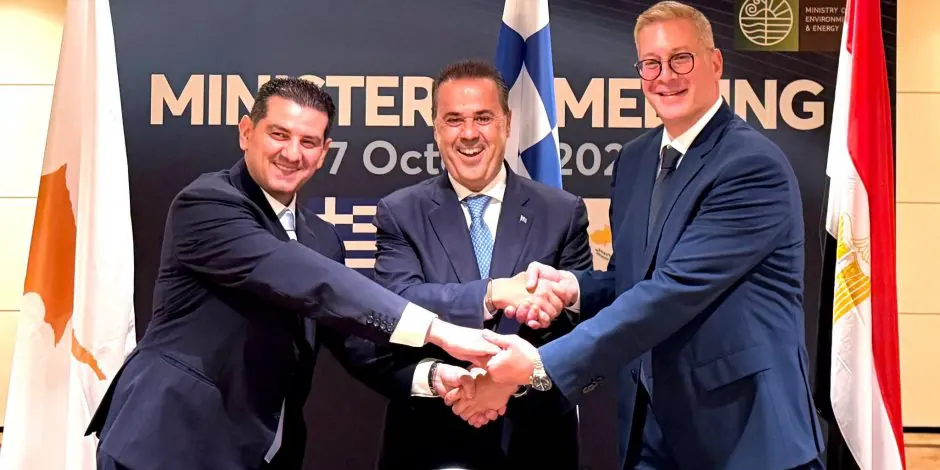
Egyptian Petroleum Minister Karim Badawi recently held a trilateral meeting with Cyprus' Minister of Environment and Energy, Stavros Papastavrou, and Cyprus' Minister of Energy, Michael Damianou, in Athens. The meeting was attended by Egypt's Ambassador to Athens, Murad Yisri Murad. The discussions focused on enhancing cooperation in the energy sector under the Egypt-Cyprus-Greece trilateral cooperation mechanism. The main agenda included accelerating the exploitation of natural gas resources in the Eastern Mediterranean and connecting them to European markets.
Minister Badawi emphasized that Egypt, Cyprus, and Greece possess complementary elements that allow for the development of an effective regional gas and energy system. Cyprus has promising gas resources, while Egypt boasts a developed infrastructure for transporting, processing, and exporting liquefied natural gas. Greece's strategic location and connection networks enable access to southern and central European markets. Badawi highlighted the importance of converting these elements into tangible projects with technical and commercial feasibility.
The meeting reviewed the latest developments and plans for developing Cyprus' gas resources, particularly the "Cronus" and "Aphrodite" projects. These projects aim to utilize Egypt's infrastructure to transport, process, and re-export gas through Egypt, thereby accelerating the exploitation of these resources and achieving the best possible economic returns for Egypt, Cyprus, and their investment partners.
The ministers also discussed the development and integration of the regional gas infrastructure, improving the efficiency and utilization of existing infrastructure, and studying the needs for expanding capacities and facilities in line with the growth of gas resources in the Eastern Mediterranean and evolving demand in target markets.
The meeting highlighted the importance of leveraging Greece's location and networks, as well as the vertical corridor for gas transport, to open effective pathways for Eastern Mediterranean gas to reach southern and central European markets. This would support the diversification of supply sources and enhance the interconnectedness of European energy markets.
Minister Badawi stressed that integrating Egypt's infrastructure with Eastern Mediterranean resources and European connection networks would strengthen Egypt's role as a regional hub for gas trading and commerce. This would also pave the way for more cross-border projects that achieve common interests for participating countries.
The ministers agreed on the need to build on current efforts to transition from the stage of opportunities and plans to the actual implementation of priority projects. This involves intensifying coordination between governments and companies, addressing technical, commercial, and regulatory challenges, and pushing eligible projects towards making final investment decisions and starting execution.
Key points
- Egypt, Cyprus, and Greece are working together to accelerate the exploitation of natural gas resources in the Eastern Mediterranean and connect them to European markets.
- The countries aim to develop an effective regional gas and energy system by leveraging their complementary elements, including promising gas resources, developed infrastructure, and strategic locations.
- The trilateral cooperation seeks to enhance energy security, promote economic returns, and support the growth of the regional energy sector.