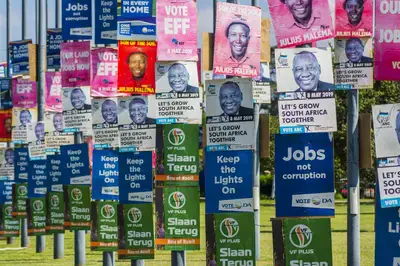
The outcome of South Africa's 2026 local government elections will be determined by the number of registered voters who turn up at the ballot box, rather than rally crowds, opinion polls, or social-media sentiment. Local governance relies on a combination of proportional representation and ward contests across 257 municipalities, making actual turnout the definitive driver of political power.
Following historic lows in voter participation during the 2021 municipal elections, differential turnout continues to reshape council seats and fuel the rise of hung councils. In 2021, voter turnout declined from 57.94% in 2016 to about 45.79%, the lowest recorded level in the local elections held between 2000 and 2021, with roughly 12.3 million of the approximately 26.1 million registered voters casting ballots.
The 2021 local government elections demonstrated that the actual composition of the participating electorate differs materially from the composition of the eligible or registered electorate. Parties whose supporters convert intention into ballots will register stronger results than parties whose supporters remain at home; the absolute size of a support base is secondary to the rate at which that base participates.
Demographic composition matters, as younger eligible voters constitute a substantial share of the voting-age population, and their presence or absence shifts the character of the participating electorate and, by extension, the policy priorities that municipal councils are likely to reflect. Geographic variation compounds that effect, with turnout rarely uniform across wards, towns, and metropolitan areas.
Local elections are, by design, a series of concurrent municipal contests rather than a single national plebiscite, and variations in turnout feed directly into the formation of local government councils. Where no party secures an outright majority, the precise allocation of seats determines which combinations of parties can negotiate governing arrangements.
National popularity, measured by opinion polls or aggregate vote share, remains an incomplete guide, and accurate assessment requires examination at the municipal and ward levels. A party may improve its national percentage yet fail to win wards or secure majorities in specific municipalities, while a party with concentrated support in particular communities may win critical wards without dominating nationally.
Higher turnout does not automatically advantage any single party, but its effects depend on which registered voters participate, the choices they make, and the specific electoral thresholds operative in their municipalities. Ultimately, sustained participation strengthens the link between citizen preferences and institutional decisions, reinforcing the accountability mechanisms that local government is constitutionally intended to provide.
Key points
- Voter turnout will play a decisive role in shaping councils across South Africa's 257 municipalities.
- Actual participation, rather than expressed support, determines council seats and municipal leadership.
- Differential turnout can reshape the architecture of local authority for an entire five-year term.