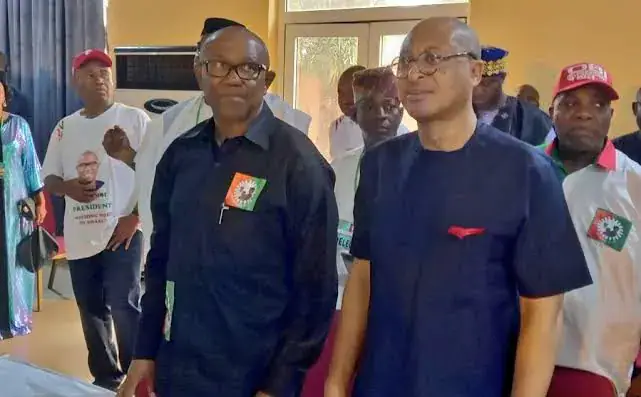
Political economist and Nigeria Democratic Congress (NDC) chieftain, Pat Utomi, has outlined the party's economic blueprint for presidential candidate Peter Obi's 2027 campaign. A key component of the plan is strengthening the naira to N500 per dollar. This target forms part of a broader strategy to reduce inflation, tackle poverty, and improve the purchasing power of Nigerians. The proposed exchange rate appreciation is central to the NDC's economic strategy.
According to Utomi, achieving a stronger naira would involve increased investments in security, electricity, and road infrastructure, as well as structural reforms aimed at improving market competitiveness. The economist projects that these measures would significantly reduce the cost of food and other basic necessities. For instance, a loaf of sliced bread currently selling for N1,750 could fall to N800. Similarly, the price of a 50kg bag of imported rice could drop from N55,000 to N27,500.
Utomi outlined further projected price reductions for essential commodities under the proposed economic programme. A medium-sized tuber of yam would decline from N2,400 to N1,200, while a 50kg bag of maize could sell for N37,500, against its current price of N75,000. Other projected price reductions include a bunch of plantain from N2,500 to N1,250, whole chicken from N7,000 to N3,500, and a dozen eggs from N2,300 to N1,150.
The proposed economic programme also aims to improve the welfare of Nigerians, particularly the 140 million facing multidimensional poverty. Utomi described the plan as a direct approach to addressing the country's economic challenges, offering a multi-faceted strategy to curb inflation, reduce poverty, and lower the cost of living. The NDC's economic strategy is designed to uplift millions of Nigerians currently experiencing poverty.
At the official Nigerian Foreign Exchange Market (NFEM), the naira traded at N1,346.86 to the dollar on Friday, while the dollar exchanged for about N1,385 in the parallel market. Achieving the N500 target from the prevailing official market rate would require an appreciation of approximately 63 per cent. This raises questions about the policy measures and economic conditions necessary to sustain such a movement.
The naira came under significant pressure in 2023 following President Bola Tinubu's decision to implement major economic reforms, including changes to the foreign exchange regime. The reforms triggered a sharp depreciation of the local currency, with the resulting exchange rate pressures contributing to rising prices of goods and services and a decline in household purchasing power.
Utomi did not indicate how soon an exchange rate of N500 per dollar could be achieved or provide details of the monetary and fiscal policies that would support such a significant appreciation of the naira. The economist's proposal has sparked interest and debate among economic analysts and Nigerians, who are eager to see the implementation of policies that could improve the country's economic situation.
Key points
- Peter Obi's economic plan includes strengthening the naira to N500 per dollar if elected president in 2027.
- The proposed exchange rate appreciation is part of a broader strategy to reduce inflation, tackle poverty, and improve the purchasing power of Nigerians.
- Achieving the N500 target would require an appreciation of approximately 63 per cent from the prevailing official market rate.