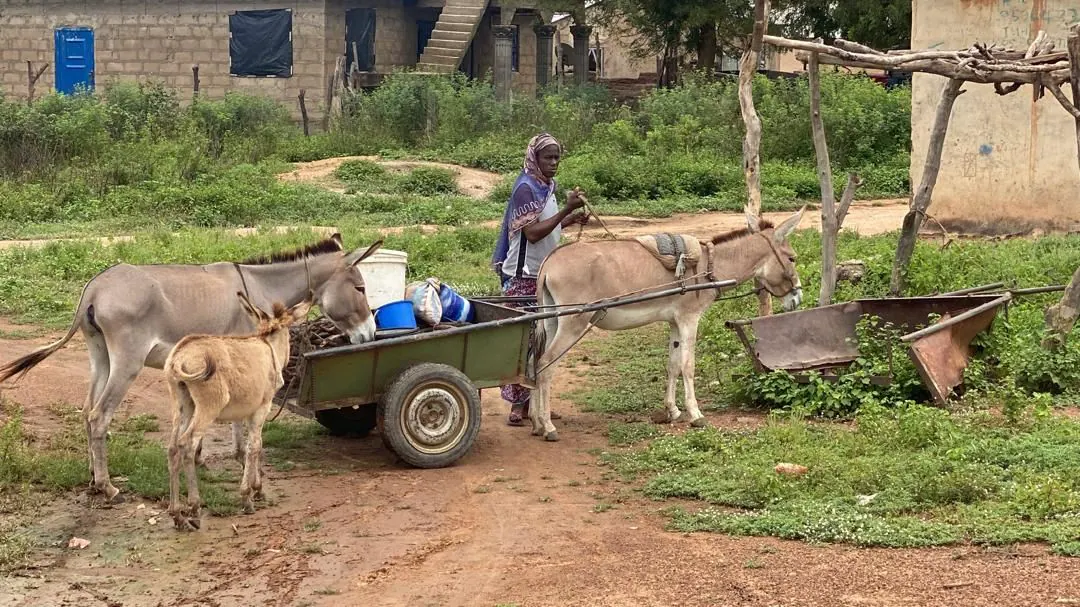
Residents of Kupulima and other communities in Ghana's Sissala West District face significant transportation challenges due to poverty. The area remains cut off from motorized transport, making everyday life difficult for residents. The lack of modern transportation technology has led to a reliance on donkeys and donkey carts to move people and goods. This traditional mode of transportation has become an essential part of life in the district. Donkeys play a vital role in agriculture, enabling residents to access areas that vehicles cannot.
The population of donkeys in the district has increased significantly, almost matching the human population. This reflects the importance of donkeys to livelihoods in the area. During both the dry and rainy seasons, donkeys are crucial in agriculture, providing a reliable means of transporting goods and services. Their ability to access areas that vehicles cannot makes them an indispensable asset to residents. However, their slow movement can affect real-time mobility and reduce productivity.
Donkeys also ease the hardship residents face in accessing water. They carry heavy loads of water in cans and drums for household use and farm work. Women in the community manage these donkeys with pride, serving as guides and operators. They use the animals to go to farms, fetch water and firewood, and carry foodstuffs to markets. The donkeys have become an integral part of daily life in the district.
Despite their usefulness, the donkeys are at risk due to the high demand for donkey skins for export to China and other parts of Asia. Merchants and traders have turned the Sissala West District into a major supply hub, leading to concerns that the donkey population is being depleted. Residents fear that soon there will be no donkeys left to make life manageable. The depletion of the donkey population could have severe consequences for the community.
The Assemblyman for the Kupulima Electoral Area, Katarah Batong, has expressed worry about the impact of poverty on residents' lives. He noted that the community is behind modern civilization when it comes to transportation, with donkeys doing the work of machines. Batong emphasized that poverty has forced the community to use donkeys as an alternative means of transport. He also highlighted the risk of losing donkeys due to the donkey skin business.
The lack of modern transportation in the district is evident, with only a few tricycles and motorbikes available. During a five-hour visit to Kupulima, only three tricycles were seen, and they were not from the community but had come to deliver goods from Tumu in the Sissala East Municipality. The limited availability of motorized transport makes it difficult for residents to access commercial transport, except by using a personal motorbike or car.
Despite these challenges, residents continue to use donkeys to carry goods to major towns within the Upper West Region. The donkeys provide a vital link to the outside world, enabling residents to transport goods and services. However, the community's reliance on donkeys is unsustainable in the long term, and alternative transportation solutions are needed to support the community's development.
Key points
- The use of donkeys for transportation in Ghana's Sissala West District has increased due to poverty and lack of modern transportation technology.
- The donkey population is at risk due to the high demand for donkey skins for export to Asia.
- The community's reliance on donkeys is unsustainable, and alternative transportation solutions are needed to support development.