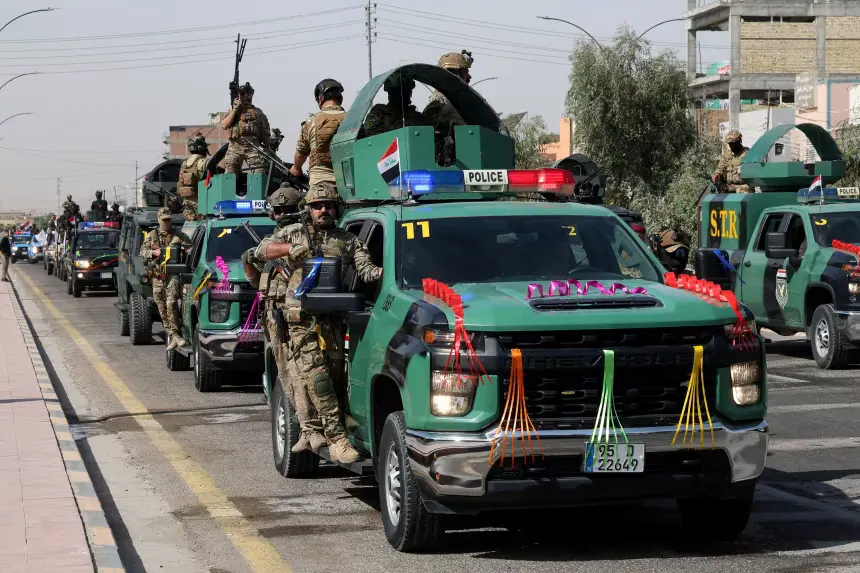
The United States announced on Wednesday that it had completed its withdrawal from Iraq, a move that was celebrated by the Iraqi government, the Pentagon, and Iran and its allies. The withdrawal was completed after US troops left their last remaining bases in Erbil, northern Iraq. This milestone reflects the success of a 12-year campaign that defeated ISIS as an organized military threat in Iraq and across the region.
The withdrawal marks a transition from a wartime coalition mission to an Iraqi-led security effort supported by a more normal bilateral security relationship. Pentagon spokesperson Sean Parnell said in a statement that the primary responsibility for addressing Iraq's remaining security challenges, including ISIS and Iran-aligned militias, now rests with the Iraqi government. The US had 170,000 troops in Iraq at its height before the Obama administration withdrew the forces from the country in 2011.
About 5,000 troops were deployed to Iraq in 2014 at the request of the Iraqi government to fight against ISIS. Since December 2021, the US has had roughly 2,500 troops in Iraq in an advise and assist capacity, working to train the Iraqi military to fight ISIS. The American presence in Iraq spanned more than two decades and several missions. The last mission, a 12-year campaign against ISIS, sought to dismantle the Sunni extremist group that carved out territory across Syria and Iraq in the mid-2010s.
Iranian-supported militias, such as As'hab Al-Kahf, cheered the US exit, congratulating Iraqis on the humiliating withdrawal of the American occupier under the strikes of the Resistance's drones and missiles. Iraqi Prime Minister Ali al-Zaidi presided over the handover ceremony and described the US withdrawal as the beginning of a new phase, one defined by Iraq's sovereignty, the strength of its institutions, and balanced partnerships with its friends.
The US withdrawal comes as several regional governments launch efforts to disarm Iran's powerful militias, who have grown powerful with political, financial, and military influence within Arab countries. For three years, Iran has been losing influence in key areas across the Middle East. Lebanon's Hezbollah was severely weakened by an Israeli invasion into southern Lebanese villages, and the fall of Iran's ally in Syria, Bashar al-Assad, has forced Iranian groups to concede strategic territory.
Experts are doubtful that the Iraqi government will be able to disarm the Iran-loyal groups even if war between Iran and the US ends. Lahib Higel, deputy program director for the Middle East and North Africa at International Crisis Group, said it's quite an impossible task to quickly disarm these groups. For as long as the regime stands in Tehran, it would be very difficult to imagine that the groups would lay down their arms.
Iraq's new prime minister, Ali al-Zaidi, has pledged no weapon outside the umbrella of the law, and no force outside the state's institutions. However, Iranian proxies have proven useful in adding pressure on Washington's allies in the region. This month, Iraqi groups loyal to Iran fired drones on a vital Saudi oil pipeline, disrupting global crude supply and leaving oil prices soaring.
Key points
- The US withdrawal from Iraq marks a significant shift in the country's security landscape.
- Iran-aligned militias have grown powerful in Iraq and are unlikely to disarm.
- The Iraqi government faces a daunting task in loosening Iran's grip on its neighbor.