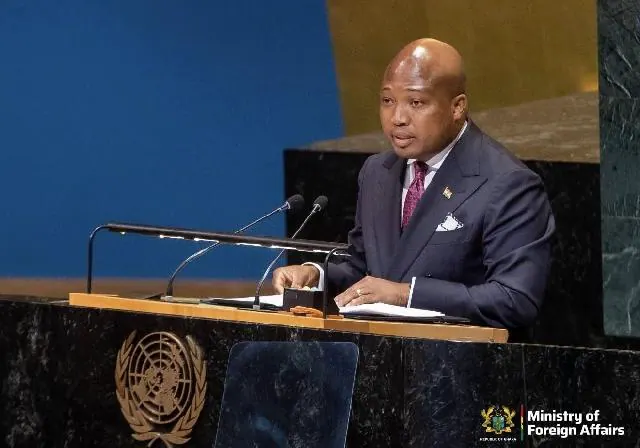
United States authorities have formally communicated their willingness to engage with Ghana on its reparatory justice agenda, despite Washington having voted against the Ghana-sponsored United Nations resolution on the historical legacy of the transatlantic slave trade. This disclosure was made by Foreign Affairs Minister Samuel Okudzeto Ablakwa on Wednesday, September 23, 2026, while addressing the High Level Side Event on the Next Steps in New York.
The United Nations General Assembly resolution, adopted on March 25, 2026, recognised the transatlantic trafficking of enslaved Africans and the system of racialised chattel enslavement of Africans as the gravest crime against humanity. The resolution called for measures addressing the historical and continuing consequences of slavery, securing 123 votes in favour, while the United States, Israel, and Argentina voted against it. Fifty-two countries abstained from the vote.
According to Minister Ablakwa, Ghana had received formal communication from the United States expressing its readiness to cooperate with the country despite its position during the United Nations vote. He stated that the communication represented an indication that Washington remained prepared to engage Ghana on areas of mutual interest within the broader pursuit of reparatory justice.
The Minister emphasised that Ghana’s objective was to promote dialogue, reconciliation, and a broader international effort to address the consequences of historical injustice. He maintained that the Ghana-led effort was not about dividing the world but rather about bringing nations together, healing, and genuine reconciliation.
Minister Ablakwa further highlighted President John Dramani Mahama’s commitment to pursuing the reparatory justice initiative through international cooperation and dialogue. He said the Ghanaian President was approaching the initiative with the objective of securing practical international cooperation rather than pursuing concealed political or diplomatic interests.
Ghana has established three international mechanisms to advance the reparatory justice agenda, namely the High Level Advisory Council on Reparatory Justice, the Global Experts Panel on the Restitution of Cultural Heritage, and the Global Legal Panel on Reparatory Justice. The panels were established following the Next Steps Conference on Reparatory Justice held in Accra in June 2026.
The Minister placed particular emphasis on the restitution of African cultural artefacts, describing their return as an important practical component of the reparatory justice process. He commended France, Germany, and the Netherlands for their stated willingness to return African cultural artefacts and encouraged other countries holding African heritage objects to pursue similar arrangements.
Key points
- The US has expressed willingness to engage with Ghana on reparatory justice despite voting against a UN resolution on the issue.
- Ghana has established three international mechanisms to advance the reparatory justice agenda.
- The restitution of African cultural artefacts is a key aspect of Ghana's reparatory justice agenda.