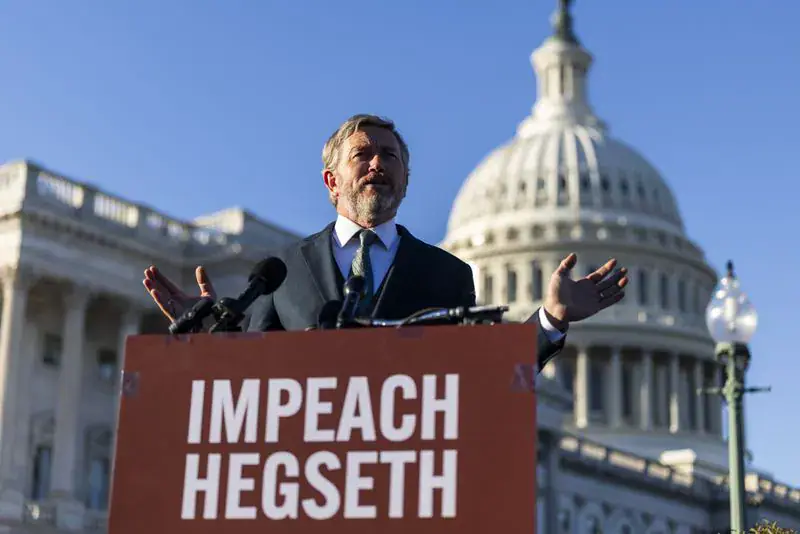
US Secretary of Defense Pete Hegseth is set to face a House impeachment vote this week. Republican lawmaker Thomas Massie from Kentucky introduced eight articles of impeachment against Hegseth, citing alleged abuses of power, including waging war against Iran without congressional approval. The move comes as Hegseth has been trying to rebrand the US military, which he said was too weak and "woke" when he took office last year.
Hegseth's impeachment proceedings draw parallels with William Belknap, the only civilian leader of the US military to be impeached by Congress in 1876. Belknap was accused of taking huge kickbacks and handed his resignation to President Ulysses Grant ahead of his scheduled impeachment vote. In contrast, Hegseth has vowed to stay and fight, mounting a social media campaign and comparing himself to President Donald Trump, who was impeached twice.
President Trump has strongly defended Hegseth, citing the US military's performance in Iran and Venezuela. Trump told Reuters that Hegseth "won two wars" and questioned how he could be impeached. He later told a White House press conference that he would stand by Hegseth even if he is impeached. House Speaker Mike Johnson has also opposed the impeachment effort, saying it would be "a terrible thing for our allies and our enemies to see" in the middle of hostilities abroad.
The impeachment push has sparked concerns about defense spending, with some Republican lawmakers worried that Hegseth's strained relationship with Congress will undermine the Trump administration's push for a $1.5 trillion defense spending package. Massie warned that impeachment would be "much gentler" than what's in store for Hegseth once Democrats take control in January. Democrats have promised to investigate Hegseth over issues including the firing of the chairman of the Joint Chiefs of Staff and other senior leaders.
US Representative Thomas Massie introduced the eight articles of impeachment, accusing Hegseth of "high crimes and misdemeanors" ranging from waging the Iran war to various alleged abuses of power. Hegseth has also faced criticism for his handling of the war in Iran, which is at an impasse, and with Venezuela, where the US military deposed President Nicolás Maduro in a surprise January commando raid.
Congressional sources say the resolution may have the votes to pass even with President Trump's Republicans still controlling the House until Democrats take over on January 3. However, conviction appears unlikely in the Senate, where a two-thirds majority is required and Republicans hold 53 of 100 seats. US Senator Chuck Schumer, a New York Democrat, said the Senate needs to put Hegseth on trial.
Hegseth's fate remains uncertain as the House prepares to vote on the impeachment articles. The outcome will have significant implications for the Trump administration and the US military. Key issues, including defense spending and the war in Iran, will likely be affected by the impeachment proceedings.
Key points
- The House will vote on eight articles of impeachment against US Secretary of Defense Pete Hegseth.
- President Trump has strongly defended Hegseth, citing his performance in Iran and Venezuela.
- The impeachment push has sparked concerns about defense spending and the Trump administration's priorities.