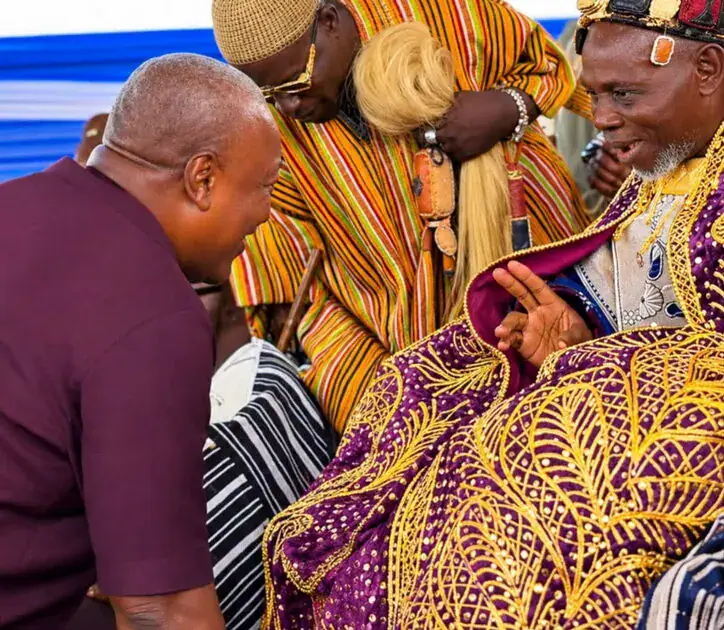
The incident occurred at the Hogbetsotso Festival in Anloga, where President Mahama bowed and knelt before the Yagbonwura, who had travelled from the north as Special Guest of Honour of the Awoamefia, Togbi Sri III. The cameras captured the moment, and social media customary law experts convened an emergency sitting to discuss the implications of the President's actions. The controversy centered on why Mahama knelt before the Yagbonwura but not before the Awoamefia, who was hosting the festival.
The debate highlighted the complexities of traditional protocol and presidential responsibilities. As a son of Gonjaland, Mahama's actions were seen as a nod to his traditional overlord. However, some argued that the President's decision to kneel before one chief but not another created an imbalance in respect. The incident drew comparisons to a previous controversy involving former President Nana Addo Dankwa Akufo-Addo, who was criticized for signalling seated chiefs to rise before exchanging greetings.
The Ministry of Chieftaincy and Religious Affairs invoked Article 57(2) of the Constitution, which gives the President precedence over all other persons in Ghana. However, critics, including Professor Raymond Atuguba, questioned the interpretation, arguing that traditional authority also enjoys constitutional protection. The controversy sparked a wider discussion about the intersection of traditional and presidential protocol.
The incident also raised questions about the role of politics in traditional settings. Some argued that the controversy was fueled by partisan politics, with some Ghanaians praising Mahama's humility while criticizing Akufo-Addo's perceived arrogance. The debate highlighted the challenges of navigating traditional and cultural norms in modern Ghana.
The Hogbetsotso Festival commemorates the Anlo people's historic escape from oppressive rule and is a celebration of freedom and collective courage. However, the controversy surrounding Mahama's kneeling gesture detracted from the festival's significance. The Yagbonwura's visit was intended to celebrate friendship between traditional kingdoms, not to supervise a presidential kneeling competition.
The controversy underscores the importance of understanding context, custom, and consent in traditional interactions. A chief who voluntarily rises to greet a President has offered courtesy, while a President who kneels before a traditional overlord has offered homage. Trouble begins when either gesture becomes a compulsory examination in political loyalty.
The incident has sparked a wider conversation about the complexities of traditional respect and presidential protocol in Ghana. As the nation continues to navigate these complexities, it is essential to prioritize context, custom, and consent in traditional interactions. The wisdom of Ghana's elders reminds us that respect is not a competition in physical exercise, but rather a nuanced understanding of cultural norms and traditions.
Key points
- The controversy surrounding President Mahama's kneeling gesture has sparked a wider debate about traditional respect and presidential protocol in Ghana.
- The incident highlights the complexities of navigating traditional and cultural norms in modern Ghana.
- The controversy underscores the importance of understanding context, custom, and consent in traditional interactions.