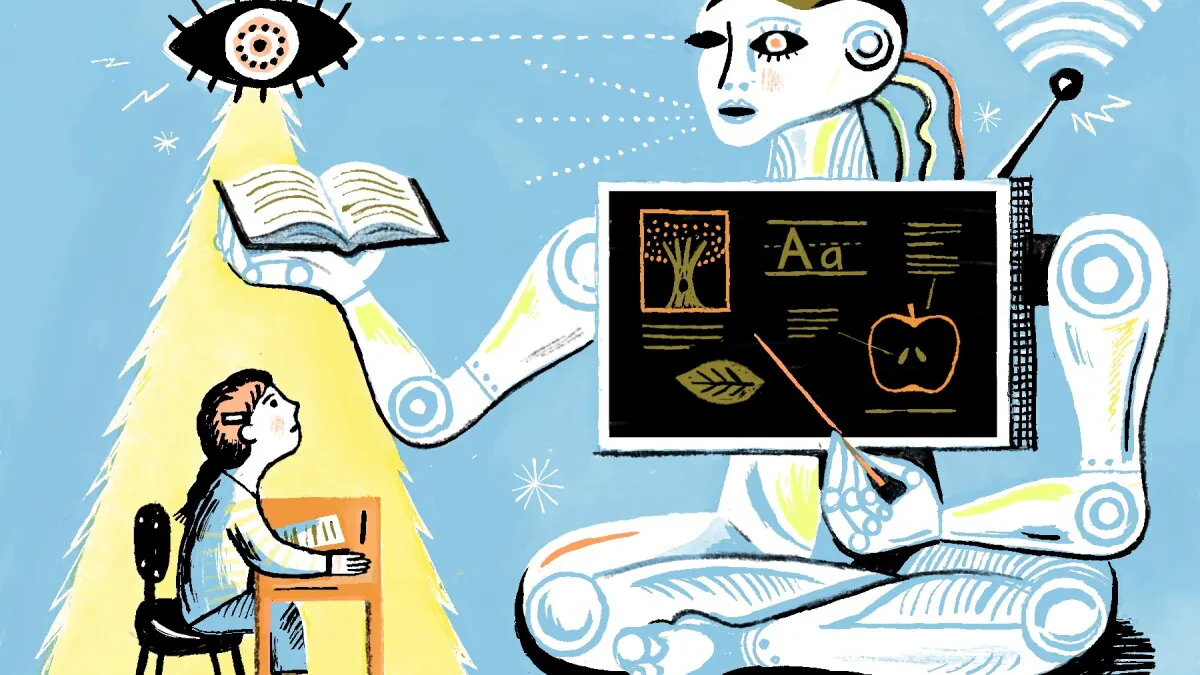
Schools across the United States are experimenting with artificial intelligence (AI) in the classroom, with some districts and educators using AI chatbots, tools to track student progress, and AI-powered humanoid robots. One such example is the Alternative School at Jackson Center in Dayton, Ohio, where students interact with a social-emotional learning chatbot named Jordan. The chatbot, designed to present as angsty, aims to help students open up about their emotions and experiences outside of school.
The Dayton Public Schools district paid $72,600 for multiple AI tools, including Jordan, and plans to continue using them. District leaders say they want to see if Jordan can help students, who often struggle with behavioral and academic challenges. Students like K, a sophomore at the alternative school, have found Jordan's responses relatable and helpful in solving their own problems. However, concerns have been raised about the lack of evidence and policy guiding these experiments.
According to a recent Stanford University review of over 800 academic papers, the research around how schools can use AI to help students and avoid potential harms is extremely limited. The review suggests that carefully designed AI tools show more promise than general-purpose chatbots. However, there is no consensus on how schools and educators should measure what works and what doesn't.
Robin Lake, director of the Center on Reinventing Public Education, says that the current state of AI adoption in K-12 schools feels like the "Wild West." Lake believes that state and federal leadership are needed to guide schools, but so far, they have been mostly hands-off. This has led to many schools forging ahead on their own, with some experimenting with AI tools without a clear understanding of their effectiveness.
Dayton Public Schools Superintendent David Lawrence says that educators must adapt to keep up with changing times and that his district is being innovative and ahead of the curve in the interest of children. However, measuring the success of AI experiments is a challenge. Mike Kentz, an external consultant, says that it's difficult to measure the success of such experiments, and that he can only get as far as perception.
Other school districts, such as Wichita Public Schools in Kansas, are also facing the challenge of measuring the value of AI initiatives. Katelyn Schoenhofer, the AI specialist for Wichita Public Schools, says that they are still trying to figure out what success means when it comes to AI use and what metric to use to evaluate it. As a result, they are introducing AI tools in controlled ways, starting with education about the technology.
Some school communities are pushing back on AI experiments, citing concerns about effectiveness and potential harms. Mark Beehler, superintendent of the Salamanca City Central School District in western New York, had planned an AI experiment but halted it due to community outrage. The debate around AI in schools is ongoing, with some educators and experts calling for caution and more research.
Key points
- Limited research exists on the effectiveness of AI tools in schools.
- Schools are experimenting with AI tools despite the lack of evidence and policy.
- Measuring the success of AI experiments in schools is a significant challenge.