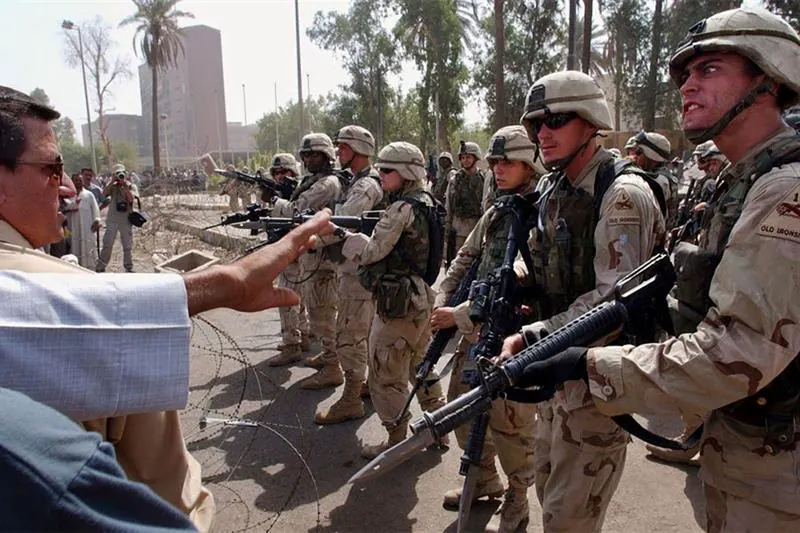
The United States and its coalition partners have formally concluded their military mission against jihadists in Iraq, following the withdrawal of troops from Erbil airbase in the Kurdistan region. The mission, which began in 2003, was initially aimed at toppling Saddam Hussein but later shifted to fighting the Islamic State group. The US-led coalition has been instrumental in defeating IS, but its presence has been a contentious issue in Iraq.
The US occupation of Iraq in 2003 led to widespread resistance, atrocities, and economic turmoil. The disbanding of the Iraqi army and torture in Abu Ghraib prison triggered a wave of armed resistance, plunging the country into devastating civil strife. Although US troops departed in 2011, a smaller US-led mission resumed in 2014 to combat the Islamic State group, which had seized large swaths of territory. With IS reduced to scattered sleeper cells, Washington and Baghdad agreed to wind down the mission.
The US-led coalition's presence in Iraq was gradually reduced, with troops withdrawing from bases across the country and restricting their presence to the autonomous northern Kurdish region. The Pentagon's chief spokesman, Sean Parnell, confirmed that the coalition had formally concluded Operation Inherent Resolve in Iraq, consistent with the September 2024 US-Iraq joint statement and US national interests. The withdrawal of coalition forces and equipment from Erbil Air Base marks the successful conclusion of the military mission.
Iraqi Prime Minister Ali al-Zaidi hailed the end of the mission as the start of a new chapter, defined by Iraq's sovereignty, institutional strength, and balanced partnerships with its friends. He declared October 1 as Sovereignty Day, marking a significant milestone in Iraq's history. The Kurdish regional government's Peshmerga Ministry expressed concerns about the departure of US forces, citing over 1,000 drone and ballistic-missile attacks during the recent US-Iran conflict.
The US-led coalition did not defeat IS alone; Kurdish Peshmerga fighters and powerful Iraqi factions played a crucial role in crushing the extremist group. Iran-allied groups in Iraq celebrated the US withdrawal, with Abu Mujahid al-Assaf, a security official with Kataib Hezbollah militia, warning the Iraqi government not to carry out American plans. The US withdrawal has created an opening for Iran to expand its influence in the region.
The US-led coalition's conclusion of its mission in Iraq marks a transition from a wartime coalition mission to an Iraqi-led security effort supported by a more normal bilateral security relationship. The US and Iraq will maintain a security partnership, with the US providing training and advisory support to the Iraqi military. The region is likely to experience significant changes in the coming months.
The implications of the US withdrawal from Iraq are far-reaching, with potential consequences for regional stability and security. The US and its coalition partners have left a lasting legacy in Iraq, but the country's future is uncertain. As Iraq begins a new chapter, it faces significant challenges, including rebuilding its economy, strengthening its institutions, and maintaining security in the face of ongoing threats.
Key points
- The US-led coalition has formally concluded its military mission in Iraq after 12 years.
- The withdrawal of US forces has created an opening for Iran to expand its influence in the region.
- The US and Iraq will maintain a security partnership, with the US providing training and advisory support to the Iraqi military.