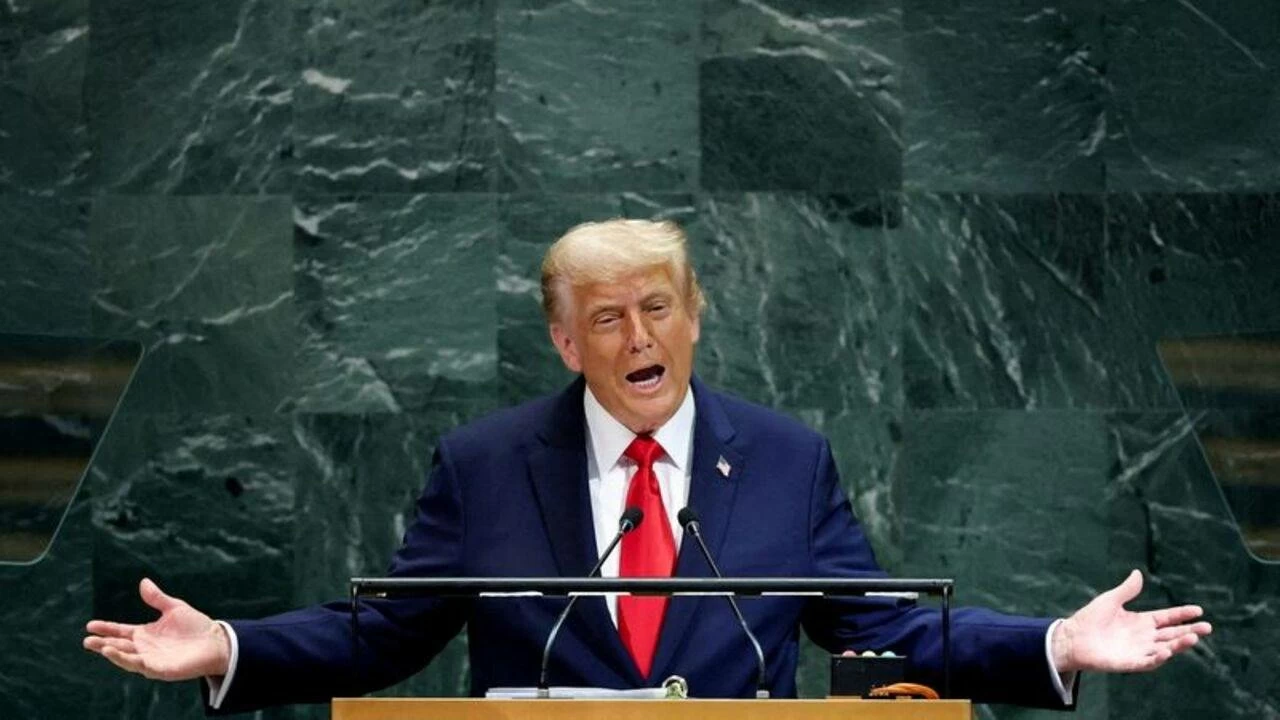
US President Donald Trump's address to the United Nations General Assembly has been subject to scrutiny, with fact-checkers questioning several claims made by him. According to a report by The New York Times, Trump's assertions on various issues, including oil reserves and the Gaza conflict, appear to be exaggerated or inaccurate. The newspaper's fact-checking exercise aimed to verify the accuracy of Trump's statements and shed light on the discrepancies.
One of Trump's claims, that the US and Venezuela together possess over 60% of the world's oil reserves, has been disputed. While Venezuela has an estimated 303 billion barrels of proven oil reserves, and the US has around 46 billion barrels, their combined reserves account for approximately 22% of the global total, not 60%. The US currently produces around 23.6 million barrels of oil per day, while Venezuela produces about 1 million barrels per day, making their combined output around 23% of global production.
Trump's assertion that he "ended the war in Gaza" has also been challenged. While he did play a role in brokering a ceasefire between Israel and Hamas in October 2025, the conflict is ongoing, with Israel continuing to carry out military operations and airstrikes in Gaza. According to the Gaza Health Ministry, over 1,000 Palestinians have been killed in Israeli military operations since October, including Hamas officials and civilians.
The New York Times' fact-checking exercise also examined Trump's claims on other issues, including US military strength and the war on drugs. Trump's assertion that the US has "more ammunition than we can think of using" has been disputed by experts, who point out that US military stockpiles are dwindling, particularly for certain types of missiles and defense systems.
Additionally, Trump's claim that the US has destroyed 97% of narcotics coming into the country via oceans and seas has been questioned. Experts argue that it is impossible to determine the actual quantity of narcotics that have not been intercepted, making it difficult to verify Trump's assertion. Data on seized narcotics only provides information on the activity of interception, not the actual volume of smuggling.
Other claims made by Trump, including the creation of over 1 million new private sector jobs and the settlement of 8 wars, have also been subject to scrutiny. While the US economy has added 807,000 jobs since Trump's second term began, this increase is not particularly remarkable by historical standards. Furthermore, Trump's role in ending wars has been overstated, with some conflicts having been ongoing for years or having little impact.
The scrutiny of Trump's claims at the UN Summit highlights the ongoing debate over the accuracy of information presented by world leaders. As governments and media outlets continue to verify the facts behind such assertions, the public's understanding of global events and policy issues will be shaped by the availability of reliable information.
Key points
- Trump's claims on oil reserves and Gaza conflict disputed by fact-checkers
- US military strength and war on drugs claims also questioned
- Scrutiny of Trump's claims highlights ongoing debate over information accuracy