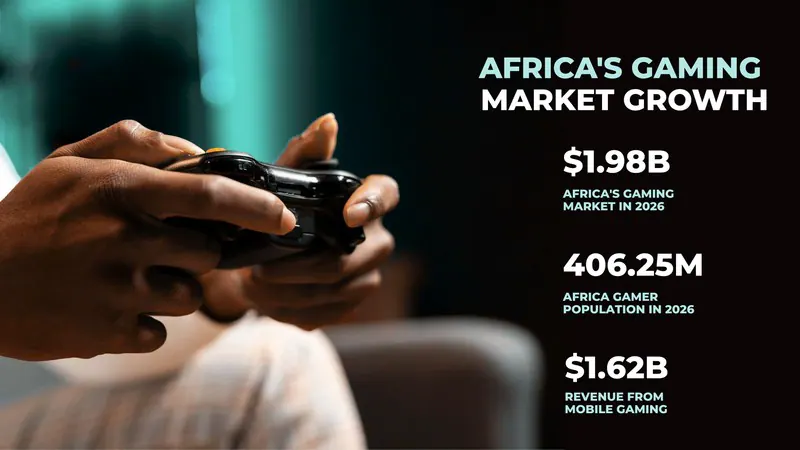
Africa's gaming industry is experiencing rapid growth, shifting from a focus on the number of players to the potential for building a billion-dollar business around them. The market is expected to reach $1.98 billion in 2026, up 11.9% from the previous year, and almost twice the global industry's 6.1% growth. This growth is driven by faster market expansion, new payment infrastructure, increasing game development capacity, and a growing calendar of competitive events across the continent.
The African gaming market is dominated by mobile gaming, with revenue forecast at $1.62 billion in 2026, representing 81.8% of the total gaming revenue. The continent is expected to have 406.25 million gamers this year, up from 369.66 million in 2025 and 186 million in 2021. Despite this large audience, Africa's gaming market remains relatively under-monetized, accounting for roughly 11% of the world's gamers but less than 1% of global gaming revenue.
Nigeria recently showcased its game development industry at Gamescom in Cologne, with a 10-member delegation of studios, developers, and publishers under the "Games from Nigeria" proposition. This appearance highlights the growing interest in African gaming and the potential for Nigerian developers to position themselves in the international games industry. The delegation showcased game development, intellectual property, research, and community initiatives as part of its effort.
The growth of African gaming is also attracting investment into payment systems and infrastructure. Carry1st has built Pay1st, a payments platform for games and digital products that supports over 200 local payment methods across Africa, including mobile money, bank transfers, and digital wallets. This platform allows players to make purchases without relying on international cards, making it easier for developers and publishers to collect smaller payments across fragmented markets.
The creative side of the industry is also developing, with gaming seen as an opportunity for African creators to turn local ideas and culture into globally distributed products. Johnny Muteba, a South African creative economy and technology advocate, notes that gaming is part of a broader opportunity for African creators. Africa's creative economy is valued at around $59 billion, but accounts for less than 3% of the global creative market, leaving room for growth and expansion.
Esports is creating another commercial layer around African gamers, with continental competitions such as the Carry1st Africa Cup and the PUBG Mobile Africa Esports Championship providing formal pathways for African players and teams. Kenya is developing its own competitive pipeline, with Rescue Esports winning the PMNC Kenya 2026 championship and Nairobi set to host the first Global Esports Cup on the continent. Device manufacturers are also moving into the market, with Infinix as the official gaming phone partner of the PUBG Mobile Africa Esports Championship.
The commercial opportunity in African gaming is concentrated in several large markets, including Egypt, South Africa, and Nigeria. Egypt is forecast to generate $458.1 million in gaming revenue in 2026, followed by South Africa at $263 million and Nigeria at $226.6 million. As the industry continues to grow, technology companies are taking notice, with Google Play's $1 million Indie Games Fund Africa expected to support 10 studios across 32 countries.
Key points
- Africa's gaming market is expected to reach $1.98 billion in 2026, driven by mobile gaming and expanding competitive events.
- The continent's large gaming audience remains relatively under-monetized, accounting for 11% of the world's gamers but less than 1% of global gaming revenue.
- Gaming is seen as an opportunity for African creators to turn local ideas and culture into globally distributed products, with the creative economy valued at around $59 billion.