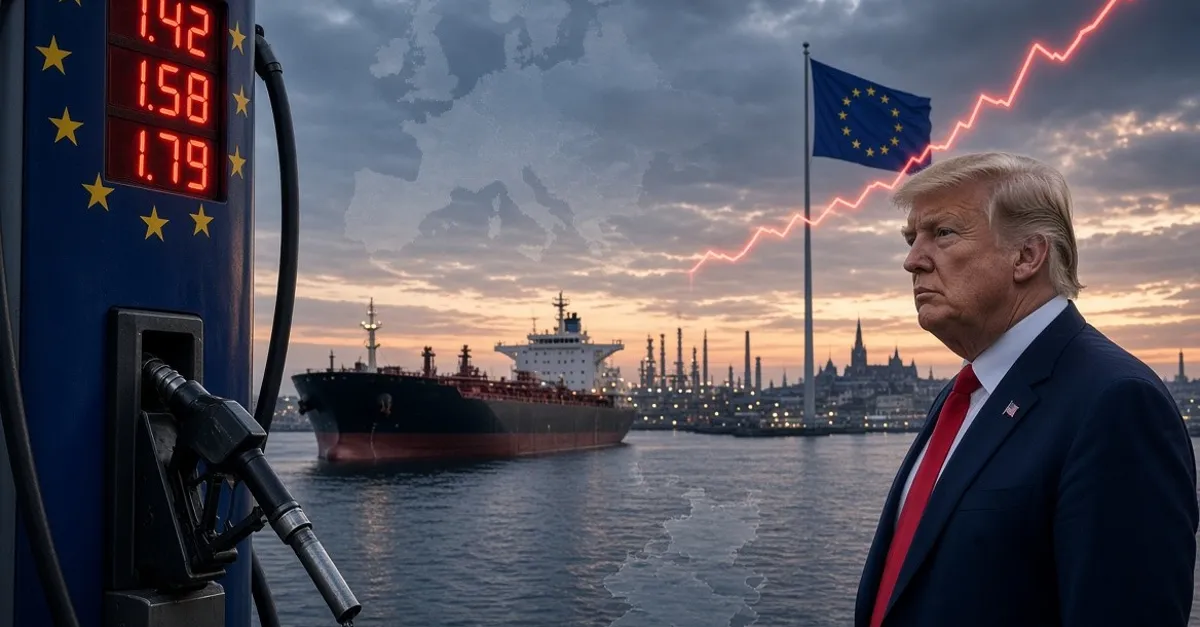
The sudden announcement by US President Donald Trump to halt diesel exports has sent shockwaves through global energy markets, pushing European diesel prices up by 7% in a single session. According to the Financial Times, the standard European diesel futures contract jumped to $1,528 per ton in early London trading, equivalent to over $200 per barrel. This significant increase came immediately after Trump's statement, in which he informed his administration not to send diesel abroad.
The markets partially recovered from their gains, stabilizing at $1,494 per ton, after US Energy Secretary Chris Wright expressed skepticism about the effectiveness of a comprehensive ban on diesel exports. At an event in New York, Wright stated that a sharp tool like a diesel export ban is not beneficial, according to Reuters. This development has raised questions about the potential impact of such a ban on global energy supplies.
The significance of US diesel exports to the global market is substantial, with the country supplying around 1.5 million barrels per day out of 8 million barrels traded globally by sea, accounting for approximately 20% of total global supplies. According to data from Kpler, Europe alone imported 506,000 barrels per day of US diesel in August, as American refineries increased production this year to meet European and Latin American demand.
European countries are now facing an uncertain situation, with analysts warning of severe consequences if the US export ban is implemented. Eugene Lindell, head of refined products analysis at FGE NexantECA, predicted that halting US diesel exports would drive global prices up to $350 per barrel, describing the scenario as "catastrophic." He emphasized that Europe would face fierce competition with Latin American countries for available diesel supplies.
The potential ban has sparked concerns about its impact on global supply chains and contracts. Lindell noted that a comprehensive ban would lead to widespread legal disputes due to long-term supply contracts between US refineries and foreign buyers. However, he doubts that the Trump administration would impose a complete ban, given the potential disruptions it would cause.
Some analysts believe that Europe may not experience an immediate shortage of diesel at fuel stations, as it relies on imports for only 20% of its needs. Benedict George, head of European refined products at Argus Media, noted that Europe benefited from the significant release of US crude oil during the conflict with Iran, allowing its refineries to operate at full capacity without depleting strategic reserves.
The proposed ban has faced opposition from US oil industry executives, who argue that it would harm the global economy and lead to higher fuel prices in the US. The American Petroleum Institute warned that a ban would remove the largest single source of fuel from global markets, exacerbating the global refining crisis and driving up prices within the US.
Key points
- The proposed US diesel export ban has sparked concerns about a potential global energy crisis.
- European diesel prices surged 7% following Trump's statement on halting diesel exports.
- Analysts warn that a comprehensive ban could drive global diesel prices up to $350 per barrel.