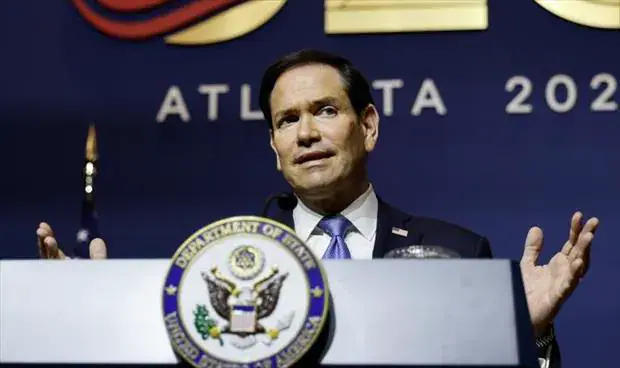
The United States has urged the international community to refrain from using food trade as a means of economic or political coercion. This appeal was made on the sidelines of a two-day meeting of G20 foreign ministers in Atlanta, Georgia. The meeting, which concluded on October 31, 2026, was hosted by US Secretary of State Marco Rubio. The discussions were overshadowed by ongoing conflicts in Ukraine and Iran.
The G20 meeting brought together foreign ministers from major economies, including China, France, Germany, India, Japan, and Russia. The US statement emphasized the need for a unified international stance against using food trade as a tool for coercion. This issue has gained significant attention in light of recent global events, including the Russia-Ukraine conflict and Iran's response to US and Israeli strikes earlier in 2026.
Secretary of State Marco Rubio acknowledged the challenges in reaching a consensus among G20 members. He stated that while there was a shared understanding of the problem, agreement on a solution proved difficult. Rubio highlighted the complexities arising from attacks on sea lanes, which have disrupted the supply of energy, fertilizers, and agricultural products.
The US statement also stressed the importance of ensuring safe and uninterrupted energy flows, including secure navigation through waterways. Global energy prices have surged since Iran closed the Strait of Hormuz in response to US and Israeli strikes. This development has significant implications for the global economy, particularly with elections in the US approaching, where energy prices are a major concern for voters.
The G20 meeting precedes a summit of leaders from the group scheduled for mid-December in Miami. Ahead of the summit, European officials sought to increase pressure on Russia, particularly to achieve a ceasefire in the Black Sea. The Black Sea is a critical passage for exporting agricultural products, and a ceasefire could help alleviate global food security concerns.
Rubio expressed optimism about achieving a ceasefire, stating that there is growing international interest in working towards an agreement. He noted that while a ceasefire would not end the war, it would address a specific aspect of the conflict. The US and its allies continue to navigate complex geopolitical relationships, seeking solutions to pressing global issues.
The G20 meeting highlighted the interconnectedness of global challenges, from food security and energy supplies to geopolitical conflicts. As the international community looks to address these issues, cooperation and consensus among major economies will be crucial. The US call for an end to using food trade as a coercion tool is a step towards fostering a more stable and secure global environment.
Key points
- The US urges an end to using food trade as economic coercion
- G20 ministers met in Atlanta to discuss global challenges
- Energy prices and food security are major concerns ahead of US elections