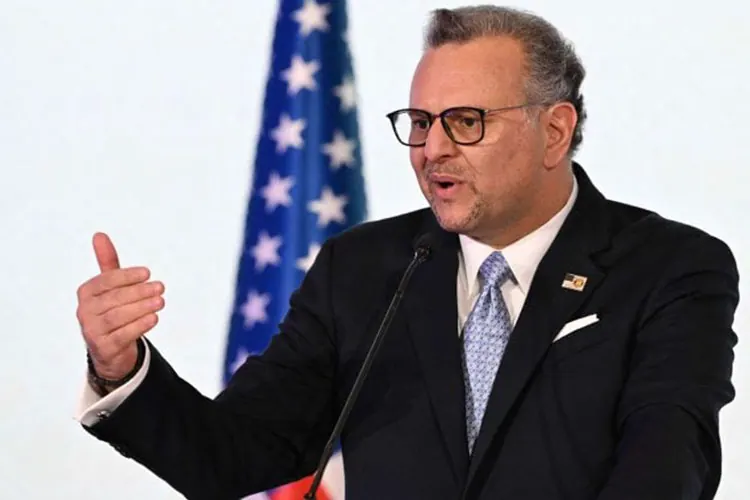
The United States has reaffirmed its support for Algeria's role in resolving the Western Sahara conflict, describing it as a "very good partner". Senior US advisor for Arab and African affairs, Masood Pulus, praised Algeria's President Abdel Majid Tebboune and his government for their constructive role in the process. Pulus's comments come amid efforts to revive stalled negotiations between Morocco, the Polisario Front, Algeria, and Mauritania.
Pulus disclosed that three rounds of negotiations have taken place so far, involving the foreign ministers of Algeria, Morocco, Mauritania, and the Polisario Front. While describing these talks as "constructive and fruitful", he noted that they have not yet led to a final agreement on the conflict. The US advisor emphasized that Algeria has provided significant assistance in this process, but stressed that it cannot impose a solution on the Sahrawi people.
The US is still awaiting comments from the Polisario Front on proposals for a potential autonomy plan, Pulus revealed. He indicated that Washington does not see an imminent solution to the Western Sahara conflict, despite recent diplomatic efforts. The US worked on UN Security Council Resolution 2797, which aims to facilitate a mutually acceptable solution. Pulus emphasized that there is still much work to be done to achieve a lasting resolution.
Pulus's comments have been interpreted as an attempt to dispel Moroccan claims that Algeria is obstructing efforts to resolve the conflict. The Algerian government has consistently maintained that it is not a party to the conflict, but rather a neighboring country committed to supporting a peaceful solution. The US advisor's statements also highlight the ongoing relevance of the UN process in addressing the Western Sahara issue.
Former Algerian ambassador Amar Belani has analyzed Pulus's comments, identifying four key messages that contradict Moroccan narratives on the conflict. Belani noted that Pulus explicitly stated that there is no imminent solution to the conflict, despite recent diplomatic efforts. He also highlighted the US expectation of a response from the Polisario Front, without specifying a deadline.
Belani further noted that Pulus's comments praised Algeria's constructive role in the process, which contrasts with Moroccan claims that Algeria is a major obstacle to a resolution. The former ambassador also emphasized that the US position underscores the need for a negotiated solution, with the Polisario Front's consent being a crucial factor. This approach, Belani argued, is at odds with Moroccan attempts to present the UN resolution as a definitive solution.
The US stance on Western Sahara has been characterized as not providing a "blank check" to Morocco, with Resolution 2797 seen as a framework for negotiations rather than a definitive solution. The ongoing diplomatic efforts aim to find a mutually acceptable solution, with Algeria's role seen as essential in supporting a peaceful and lasting resolution to the conflict.
Key points
- The US has praised Algeria's constructive role in efforts to resolve the Western Sahara conflict.
- Washington is still awaiting comments from the Polisario Front on proposals for a potential autonomy plan.
- The US position emphasizes the need for a negotiated solution, with the Polisario Front's consent being a crucial factor.