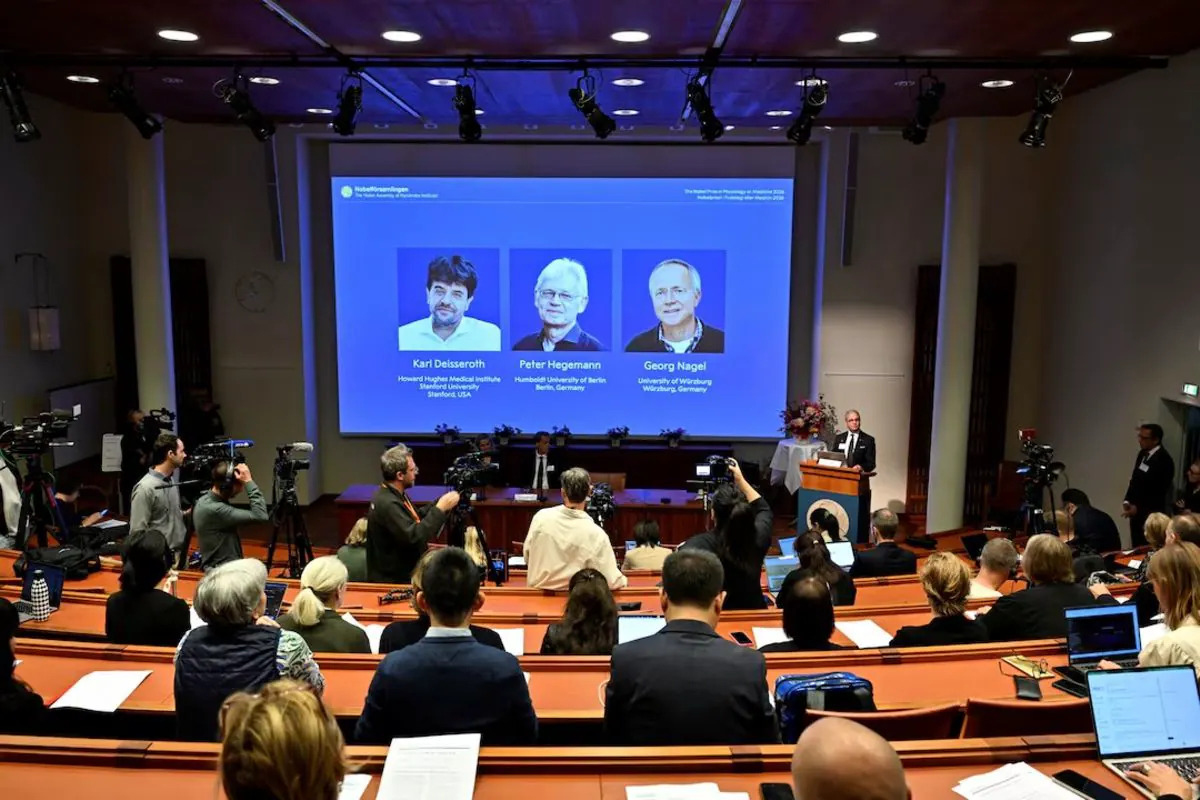
The 2026 Nobel Prize in Physiology or Medicine has been awarded to American Karl Deisseroth and Germans Peter Hegemann and Georg Nagel for developing optogenetics, a technique that uses light to control individual nerve cells in the brain. The Nobel Assembly at Sweden’s Karolinska Institutet announced the prize on Monday, citing their “discoveries concerning light-gated ion channels and optogenetics”. This breakthrough technique allows researchers to switch individual nerve cells on or off in a living brain.
Optogenetics has opened a new era in neuroscience, according to Anna Wedell, a professor of genetics and member of the Nobel Committee for Physiology or Medicine. The technique enables researchers to understand how the brain processes information and how different neurons interact across the brain. This knowledge can be used to study brain disorders such as schizophrenia, Alzheimer’s disease, Parkinson’s disease, epilepsy, and addiction. The three laureates will share a prize of 12 million Swedish kronor, worth about $1.2 million.
The research that led to optogenetics began in the early 1990s, when Hegemann investigated how the single-celled alga Chlamydomonas responds to light. He hypothesised that a single protein both detected light and acted as an ion channel, allowing electrically charged particles to pass through a cell membrane. Nagel later tested the hypothesis by introducing Chlamydomonas genes into frog eggs and discovered channelrhodopsin-2, a light-sensitive ion channel.
In 2003, Nagel and Hegemann published findings showing that the protein could be introduced into human and hamster cells, allowing light to trigger electrical impulses. Two years later, Deisseroth demonstrated that the technique could be used in rat nerve cells at Stanford University. The method was later named optogenetics in 2006. Deisseroth said he was pleased to share the prize with Hegemann and Nagel, with whom he has collaborated on research for many years.
The researchers’ work is providing new ways of studying brain disorders, with animal models being used to investigate conditions including schizophrenia, Alzheimer’s disease, and addiction. Deisseroth has used optogenetics to control the movement of mouse whiskers by activating specific nerve cells in the motor cortex. He has also used light to wake sleeping mice, helping to show how particular nerve cells are involved in wakefulness.
Researchers are also testing the technique as a potential way of restoring sight in people with retinitis pigmentosa, a progressive eye disease that causes the loss of light-sensitive cells in the retina. Scientists introduce a light-sensitive protein into the retina to stimulate healthy cells that remain after the loss of photoreceptors. This technique may also improve cochlear implants by allowing more precise stimulation of the auditory nerve than current electrical devices.
The laureates' breakthrough has expanded the possibilities of neuroscience, according to Manuel Valero, a researcher at Barcelona-based Hospital del Mar. Optogenetics has allowed researchers to control emotions, create false memories, or even recover lost memories in models of Alzheimer’s disease. However, one of the technique’s biggest challenges is turning those research findings into treatments for human brain disorders.
Key points
- The 2026 Nobel Prize in Physiology or Medicine was awarded to Karl Deisseroth, Peter Hegemann, and Georg Nagel for their work on optogenetics.
- Optogenetics uses light to control individual nerve cells in the brain, allowing researchers to study brain disorders and develop new treatments.
- The technique has the potential to restore sight in people with retinitis pigmentosa and improve cochlear implants.