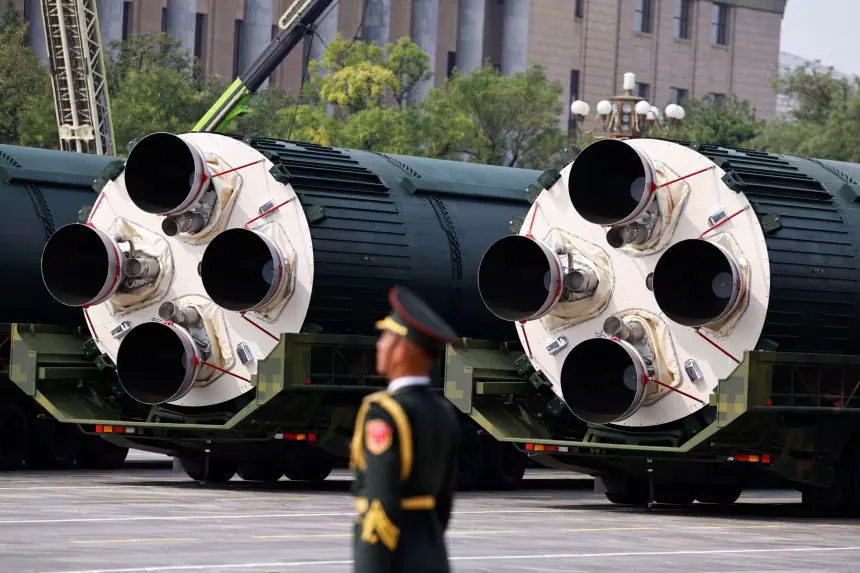
The Trump administration has engaged in informal discussions with China about reciprocal nuclear site visits, according to sources familiar with the matter. These talks aim to establish a level of trust and transparency between the two nations, which could potentially pave the way for a trilateral arms control agreement involving the US, China, and Russia. The discussions have been preliminary, and no formal talks have begun.
The idea of reciprocal visits was initially raised by the Chinese during meetings with US officials this year. The proposed visits would involve US Department of Energy national labs and China's equivalent facilities, as well as potential visits to nuclear testing sites. The US has expressed openness to discussing such visits, which could serve as a confidence-building measure. This development comes as the US and China have differing nuclear arsenals, with the US having around 5,000 warheads and China having approximately 600.
The nuclear discussions between US and Chinese officials have largely taken place on the sidelines of gatherings by the five permanent members of the United Nations Security Council, known as the P5. Despite these efforts, China remains resistant to discussions that could limit its nuclear buildup. The US has been pushing for a trilateral agreement, but China and Russia have largely ignored substantive US outreach efforts. A State Department spokesperson referred questions to the White House, which did not provide a comment.
Experts and former US officials have expressed mixed views on the potential for concrete progress on a breakthrough agreement. Some have noted that the talks could be a positive step, while others have expressed skepticism about China's motives. Paul Dean, a former acting assistant secretary of state, described reciprocal visits as "an extremely valuable confidence-building measure" that could lay the groundwork for additional work to reduce nuclear risk between the two countries.
The Trump administration has been focused on nuclear arms control, with President Donald Trump expressing support for trilateral negotiations between the US, Russia, and China during his meeting with Chinese leader Xi Jinping last month. However, Xi did not leave the door open to discussing a trilateral agreement, citing the disparity in nuclear arsenals between the US, Russia, and China. The topic of nuclear arms control is expected to remain a focus for Trump, who is scheduled to meet with Xi twice later this year.
The US and China have differing approaches to nuclear testing, with the US not having conducted any known nuclear tests since Trump's pronouncement last year about resuming testing on an "equal basis" with China and Russia. The administration has accused China of carrying out a secret nuclear test in 2020 using a technique designed to evade detection. In response, the National Nuclear Security Administration conducted a non-nuclear explosion at the Nevada National Security Site to validate new methods and equipment for detecting stealthy tests.
The proposal for reciprocal nuclear site visits and potential verification measures for low-yield nuclear testing could be shared with the P5 group later this year. While some experts see the talks as a potential glimmer of hope for reducing nuclear risk, others remain skeptical about China's intentions. As the US and China continue to engage in discussions, the international community will be watching for any signs of progress on nuclear arms control and confidence-building measures.
Key points
- The US and China are discussing reciprocal nuclear site visits as a potential confidence-building measure.
- The talks aim to establish trust and transparency between the two nations, which could pave the way for a trilateral arms control agreement.
- China remains resistant to discussions that could limit its nuclear buildup, citing the disparity in nuclear arsenals between the US, Russia, and China.