Lillian Diedericks, also known as Mama Lily, was a working-class heroine who made significant contributions to South Africa's liberation struggle. Born in 1925 in Gqeberha's Red Location, she was forced to leave school with only a Standard 3 education. However, her trilingual fluency in English, Afrikaans, and Xhosa, acquired in New Brighton, made her an effective cross-community organiser. Diedericks' politics were shaped in underground study groups run by the banned Communist Party of South Africa.
Diedericks was recruited into the South African Communist Party underground in the 1950s by Gus Coe, who recognised her determination and questioning nature. As a factory and domestic worker, she found a meaningful role in trade unions and became a shop steward in the Food and Canning Workers' Union. In 1954, she co-founded the Federation of South African Women, uniting women across racial lines. Her activism extended to various organisations, including the South African Coloured People's Organisation.
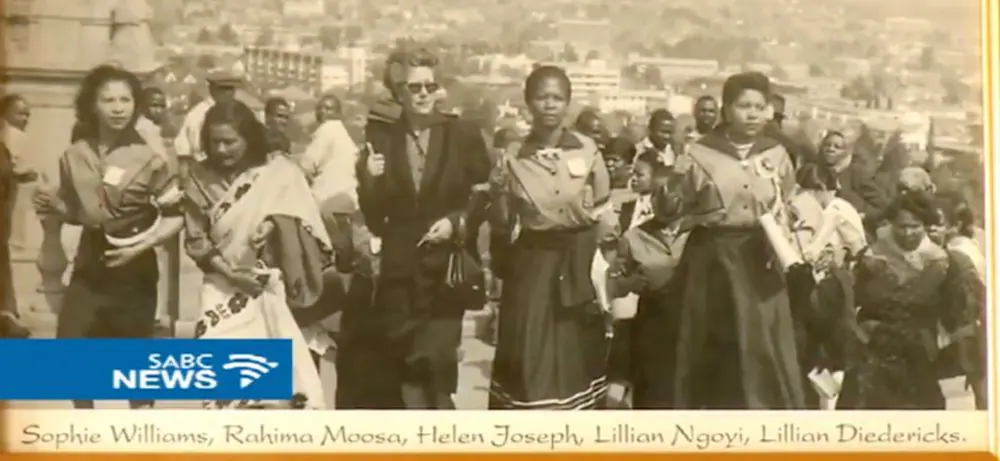
On 27 October 1955, a delegation of 2,000 women delivered petitions to the Union Buildings in Pretoria, but the Minister of Native Affairs refused to meet them. Undeterred, the women organised a larger march on 9 August 1956, with 20,000 women from diverse backgrounds participating. This event was a testament to the power of grassroots organising, with women like Diedericks building and moving between networks to mobilise support. The march was led by five women, including Diedericks, Lilian Ngoyi, Helen Joseph, Sophie de Bruyn, and Rahima Moosa.
Diedericks' activism came at great personal cost. She was arrested and charged with treason in 1956, remaining in custody until 1961. A banning order from 1963 to 1969 forced her to go underground, working with figures like Raymond Mhlaba and Govan Mbeki. The apartheid state continued to target her, and in 1971, her sister was murdered in a case of mistaken identity. Despite these challenges, Diedericks continued to speak out on issues like gender-based violence until her passing on 21 December 2021, at the age of 96.
Diedericks' contributions have not gone entirely unrecognised. In 1996, President Mandela presented her with an award for her activism. Her local municipality and the provincial government renamed their headquarters after her in 2009 and 2021, respectively. In 2014, the Red Location Museum celebrated her and other women struggle stalwarts in a year-long exhibition. She was also awarded the Order of Luthuli in Silver in 2018 for her role in the liberation struggle and the 1956 march.
Despite these acknowledgments, Diedericks felt invisible, stating in an SABC interview in 2018 that she had been "buried alive." The incomplete Women's Living Heritage Monument at Lilian Ngoyi Square in Pretoria, which features statues of four women, has been criticised for excluding Diedericks. President Zuma announced plans to add a fifth statue in 2017, but it has yet to materialise. The Amaqhawe Ethu Foundation and other activists have lobbied for Diedericks' recognition, highlighting the need for a more inclusive narrative of South Africa's liberation struggle.
The story of Lillian Diedericks serves as a reminder of the power of grassroots activism and the importance of acknowledging the contributions of all individuals who fought for freedom and equality. Her legacy continues to inspire new generations of activists and leaders. As South Africa continues to grapple with its complex history, it is essential to recognise and celebrate the lives and contributions of unsung heroes like Lillian Diedericks.
Key points
- Lillian Diedericks was a key figure in the 1956 women's march and a founding member of the Federation of South African Women.
- Despite her significant contributions, Diedericks' story has been largely overlooked, and she felt invisible even in her later years.
- Diedericks' legacy continues to inspire new generations of activists and leaders, and her story serves as a reminder of the power of grassroots activism.