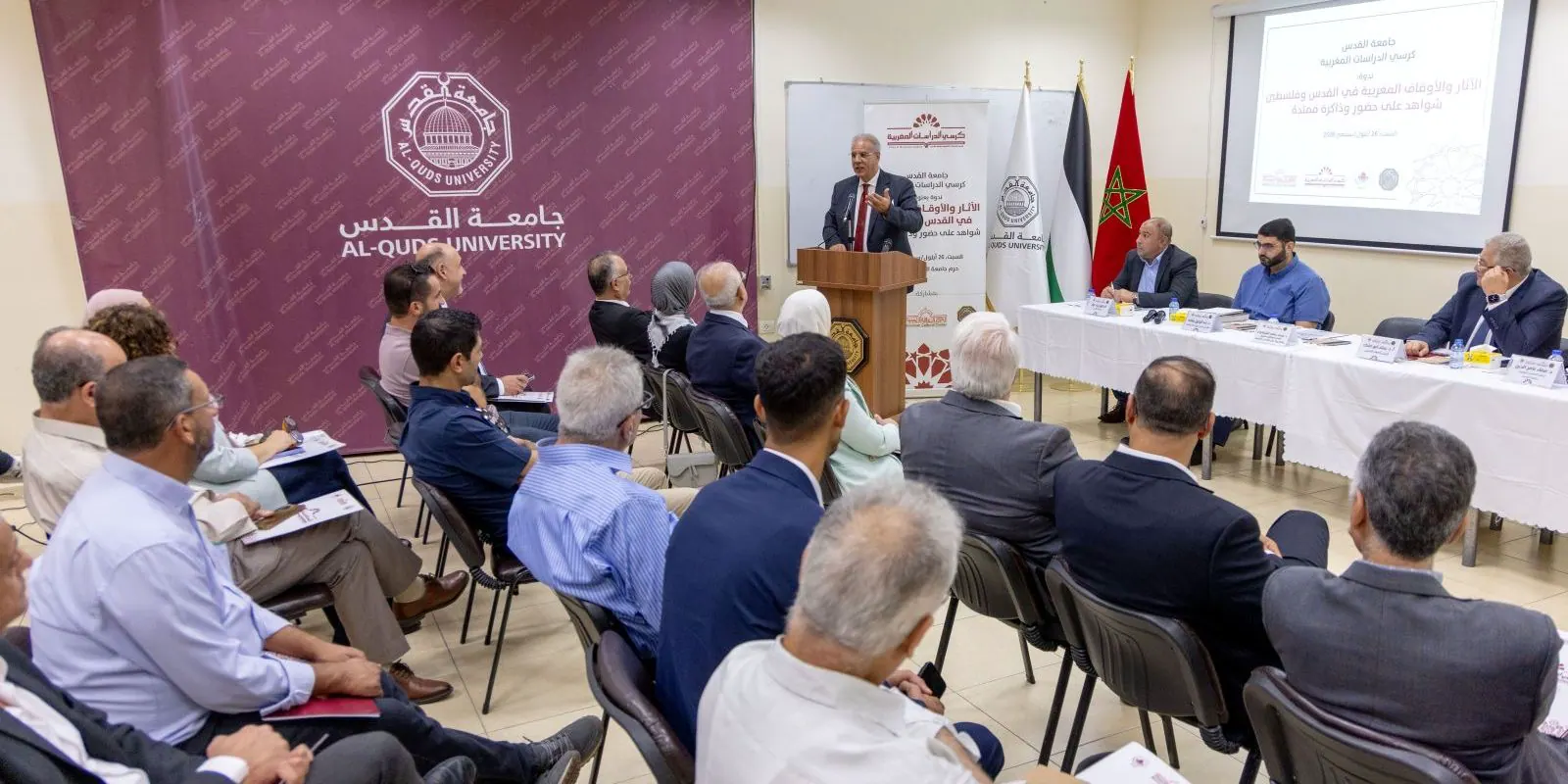
The University of Jerusalem's Chair of Moroccan Studies recently launched its new academic year with a symposium titled "Moroccan Archaeological Sites and Endowments in Jerusalem and Palestine: Evidence of a Continuous Presence and Extended Memory." The event, attended by Mohammad Salem Al-Sharqawi, Director of the Bayt Mal Al-Quds Al-Sharif Agency, and Professor Imad Abu Kshik, President of the University of Jerusalem, brought together researchers to discuss the importance of documenting Moroccan heritage in Palestine.
The symposium emphasized the need to document and preserve Moroccan archaeological sites and endowments in Jerusalem and Palestine, which are considered vital components of the region's cultural and historical heritage. Participants highlighted the significance of these sites, which serve as physical and documentary evidence of Morocco's historical presence in the region. The discussions also focused on the challenges related to preserving these sites, including the impact of change and deterioration over time.
The event featured a scientific discussion on the importance of documents, waqf records, registers, images, maps, and narratives related to Moroccan archaeological sites and endowments. Researchers also explored the challenges of documenting sites that have undergone changes or have disappeared, as well as ways to utilize modern technologies, such as archiving and digitization, to preserve the physical and documentary memory of these sites.
Symposium participants stressed the importance of enhancing cooperation between academic, cultural, and archival institutions to develop specialized scientific projects for inventorying, documenting, and studying Moroccan archaeological sites and endowments in Jerusalem and Palestine. These efforts aim to preserve the historical record and make it available to researchers and future generations, ultimately transitioning from fragmented research to more organized and systematic documentation.
Mohammad Salem Al-Sharqawi noted that the interest in scientific and cultural research related to Jerusalem is part of the ongoing efforts of His Majesty King Mohammed VI, Chairman of the Al-Quds Committee, to protect the city's cultural identity and preserve its memory. Al-Sharqawi emphasized the unique position of the Chair of Moroccan Studies within the University of Jerusalem, allowing it to play a significant role in studying the historical and cultural presence of Morocco in the region.
Safaa Nassereddine, Head of the Chair of Moroccan Studies at the University of Jerusalem, stated that the symposium aims to document Morocco's presence in Jerusalem and Palestine, transitioning from fragmented knowledge to organized and scientific documentation. She emphasized that preserving memory involves not only safeguarding sites but also producing knowledge about them and making it accessible to researchers and future generations.
The symposium concluded with a call to action, emphasizing the importance of continued collaboration and research to preserve and document Moroccan heritage in Palestine. The event demonstrated the commitment of the University of Jerusalem and the Bayt Mal Al-Quds Al-Sharif Agency to promoting cultural and scientific understanding between Morocco and Palestine.
Key points
- The University of Jerusalem hosts a symposium to discuss the preservation and documentation of Moroccan archaeological sites and endowments in Palestine.
- The event highlights the significance of these sites as physical and documentary evidence of Morocco's historical presence in the region.
- Researchers emphasize the need for cooperation and modern technologies to preserve the physical and documentary memory of these sites.