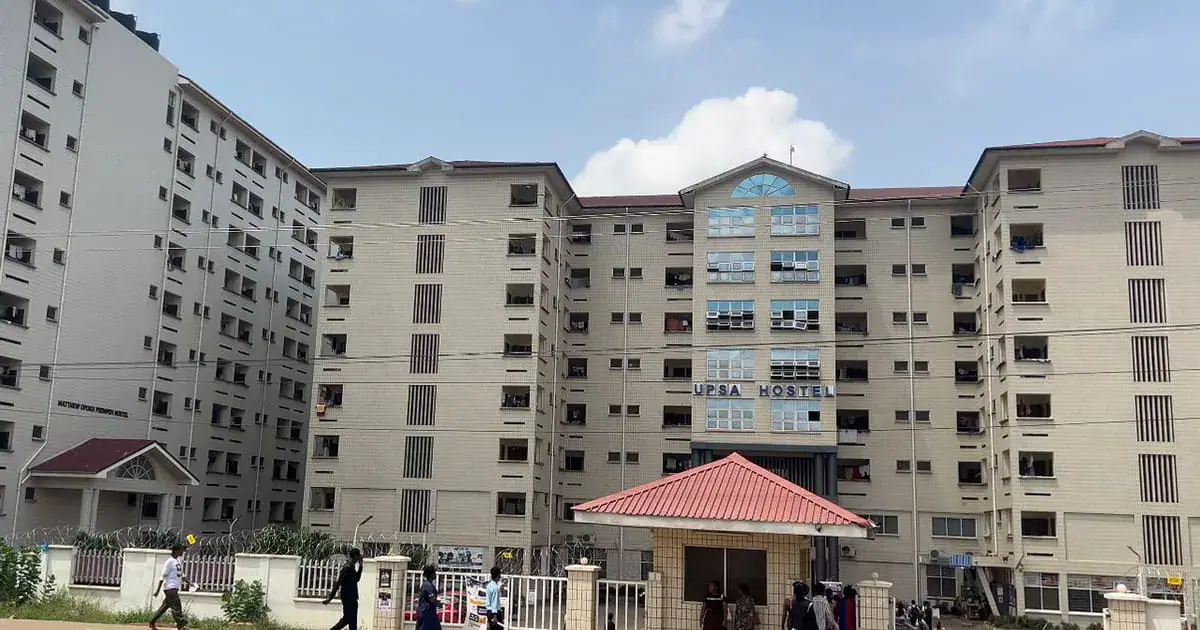
The University of Ghana's Diaspora Halls, managed by the University of Ghana Enterprises Limited (UGEL), have been at the center of a controversy over accommodation fees. The facility was financed by a GH¢43 million loan from a consortium of six banks, with the University of Ghana acting as guarantor. The loan was approved in two tranches, with the first tranche of GH¢26 million approved on February 28, 2008, and the second tranche approved on October 14, 2010.
The financing arrangement resulted in the construction of four major residential halls: Hilla Limann Hall, Alexander Adum Kwapong Hall, Elizabeth Frances Sey Hall, and Jean Nelson Aka Hall. These facilities were intended to accommodate approximately 7,000 students. The University also contributed GH¢4.2 million towards the initial project arrangement. According to the University's 2023 consolidated financial statements, UGEL is 100% owned by the University and the University acted as guarantor for the loan.
The original commercial arrangement was designed around the generation of revenue from the residential facilities. However, the Government of Ghana subsequently requested that the University operate the facilities as traditional halls of residence. The Auditor-General's 2018 special audit report disclosed that a letter from the Office of the President, dated December 4, 2014, instructed the Ministry of Finance to take over the loan facility as part of the government's debt.
The failure to meet the repayment obligations resulted in a substantial increase in the outstanding debt. As of January 19, 2016, UGEL and the University owed the syndicated banks GH¢211,718,663, including interest. The report also indicated that only GH¢8.01 million had been paid at the time. The Auditor-General attributed the continuous accumulation of the debt to the failure to implement the original repayment arrangement and the government's failure to absorb the debt stock in a timely manner.
The Auditor-General's report also identified governance and management weaknesses within UGEL, including the absence of a functional governance structure and the failure to ensure that the company's audited financial statements were properly signed, published, and filed for several years. These findings raised questions about the management of the commercial enterprise and the University's oversight responsibilities.
By December 2016, the disagreement over repayment had escalated into a legal dispute, with CAL Bank and the other members of the banking consortium pursuing legal action against the University of Ghana over the unpaid loan facility. The case was scheduled for hearing at a commercial court in Accra on December 13, 2016.
The controversy surrounding the UGEL hostel has brought renewed attention to the financial history of the University's residential facilities. The situation highlights the challenges faced by the University in managing its commercial operations and the need for effective governance and oversight. The issue remains a significant concern for students, management, and the government.
Key points
- The University of Ghana's UGEL hostel controversy reveals financial struggles with a GH¢43 million bank loan used for constructing student accommodation facilities.
- The loan was used to construct four major residential halls intended to accommodate approximately 7,000 students.
- The controversy highlights the challenges faced by the University in managing its commercial operations and the need for effective governance and oversight.