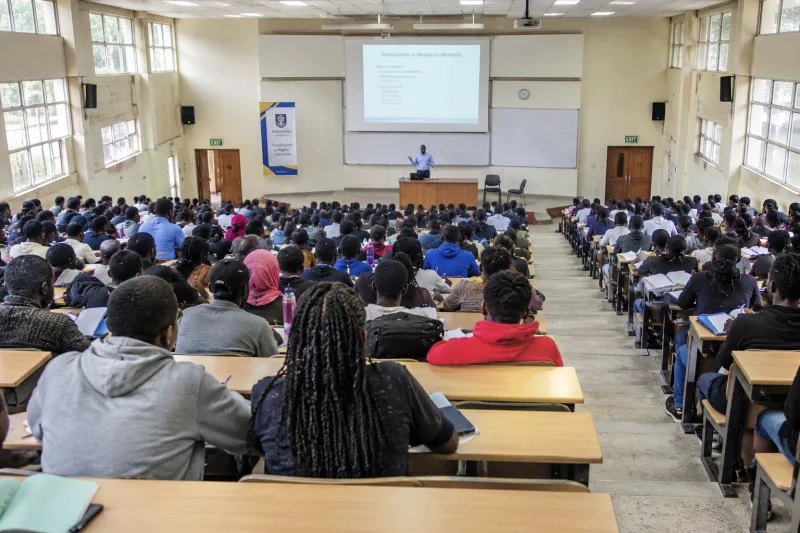
The Commission for University Education's (CUE) University Statistics Report 2025 revealed that the number of fifth-year students increased from 6,682 to 10,015, representing a 49.9% growth. This significant rise has sparked concerns about whether more learners are taking longer to complete their degrees. The report noted that this increase is not a reflection of growing university intake, but rather a larger cohort remaining in the system after the fourth year.
The CUE report highlighted that the increase in fifth-year students could be attributed to various factors, including growth in long-duration programmes, delayed completion, or improved capture of advanced cohorts. The report cautioned against drawing a single conclusion from the figures, emphasizing that not all fifth-year students are necessarily delayed. Some students may have deferred studies due to unavoidable circumstances, while others may be enrolled in programmes that extend beyond four years.
The surge in fifth-year students has prompted the commission to flag progression and completion as issues requiring closer attention. Missing marks have often been cited as a chronic problem affecting Kenyan universities, causing large numbers of students to miss or delay their graduations every year. The report emphasized the need to review programme durations and advanced-year cohorts to identify delayed completion or structural bottlenecks.
The pressure on teaching capacity, infrastructure, and student support services, particularly in large public universities, adds another layer of concern. Academic staffing has not grown at the same pace as enrolment, with a 6.4% rise in university academic staff from 15,383 in 2024 to 16,434 in 2025, against a 12.5% growth in total university enrolment. This mismatch may be particularly pronounced in public institutions.
The extended time of completion carries cost implications for students, institutions, and the public. Students who spend additional years at university incur prolonged expenditure on fees, accommodation, food, transport, and other living costs. Institutions also continue to require teaching, examination, supervision, library, laboratory, and other services for students who remain enrolled longer.
The CUE report also noted that the 10,015 fifth-year students are only part of a larger population of learners who have progressed beyond the first four years. A total of 4,466 students in their sixth and seventh years are included in the overall total but excluded from the year-of-study table. The commission's task now is to establish whether the additional students represent the normal growth of longer programmes or a widening completion bottleneck.
The 49.9% jump in fifth-year students has turned what might once have been a marginal part of university enrolment into a trend that warrants closer scrutiny. The distinction between programme structures and delayed completion matters, as it may require universities to plan capacity around longer courses or identify where students are getting stuck and why.
Key points
- The number of fifth-year university students in Kenya surged by 50% between 2024 and 2025.
- The increase in fifth-year students may be attributed to growth in long-duration programmes, delayed completion, or improved capture of advanced cohorts.
- The surge in fifth-year students has raised concerns about delayed completion of degrees and the pressure on teaching capacity, infrastructure, and student support services.