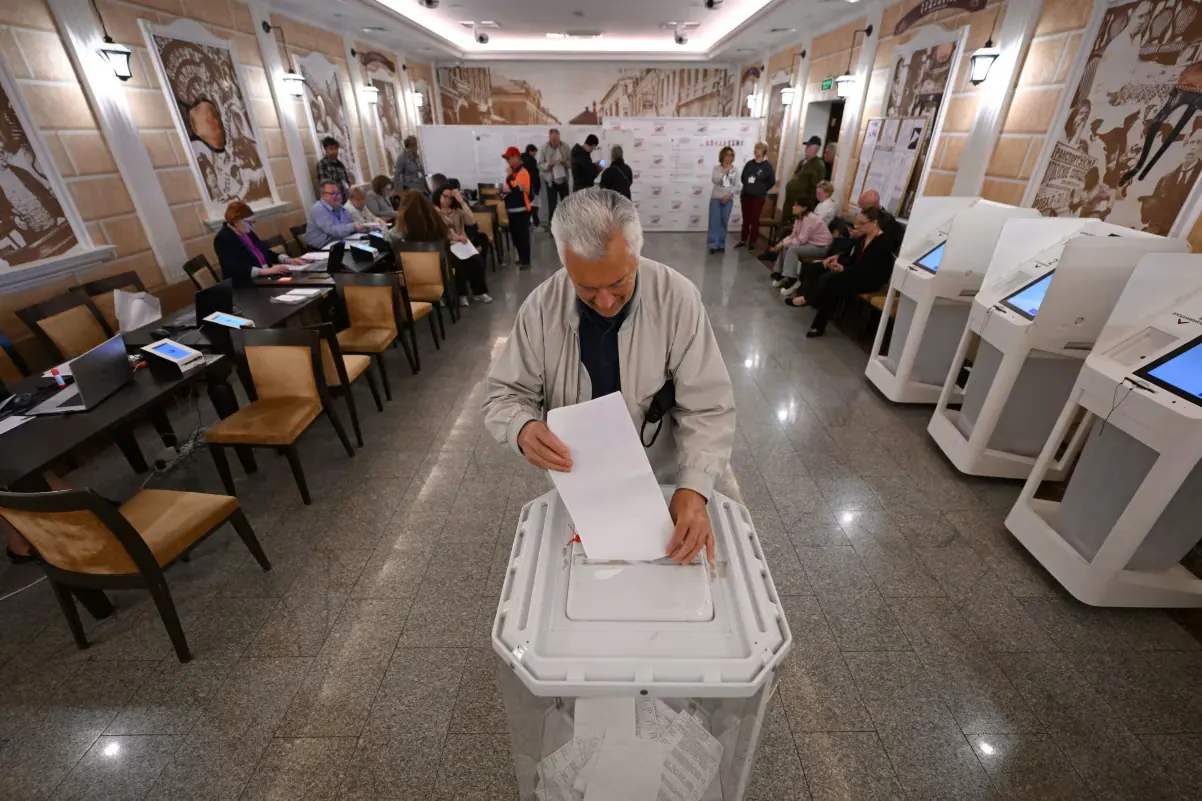
The United Russia party, which backs President Vladimir Putin, is poised to win the Russian parliamentary elections, according to initial data from the Central Election Commission. With 57.8% of votes and 95% of ballots processed, the party is in the lead. The final election results will not be tallied before September 25. The vote took place amidst a significant attack by Kyiv on Moscow, with over 1,900 drones launched, killing at least three people and damaging a major oil refinery.
The election turnout across Russia topped 59%, a new record high for parliamentary elections. If confirmed, the result will secure United Russia 355 of the 450 seats in the Duma, the lower house of the Russian parliament. This would be the highest number of seats the party has ever secured, 31 more than in the 2021 election. Putin is not a member of the party but served as its leader between 2008 and 2012. He was not on the ballot, as he is not up for election until 2030.
Meaningful opposition is effectively nonexistent in Russia, with critics either barred, in jail, or exiled abroad. Over 2,000 people are currently in prison for political reasons, according to the independent human rights monitor OVD-Info. Russia's only registered anti-war party, Yabloko, was barred from the federal party-lists election by the Supreme Court last month. Some individual Yabloko candidates were allowed to run in single-seat local districts but faced significant restrictions and pressures.
No Yabloko candidates were elected, according to preliminary results. Yabloko reported that one of its election observers "lost consciousness" while being detained at a polling station in St. Petersburg. Numerous other Yabloko observers were barred from polling stations elsewhere. The outcome of the election is likely to be used by the Kremlin to claim a stronger mandate, illustrating Russians' support for Putin and the "special military operation" in Ukraine.
Ahead of the vote, Putin signaled in a televised speech that the election results would show Russians are united behind the army. He stated that the choice and determination of voters would show that millions of people are backing Russian fighters and that they stand together, united by shared values and historical memory. Rather than the actual results, observers will likely look at turnout as an indicator of how Russians are feeling about the war and Russia's political trajectory.
Electronic voting was widely available and encouraged, with Moscow offering residents incentives in the form of points for prizes if they chose to vote electronically. Some voters in Moscow reported not being issued paper ballots due to "malfunctions" and were encouraged to vote via an electronic terminal instead. Critics have long been suspicious of the Kremlin's introduction of electronic voting, arguing it is less transparent. Russian authorities reject criticism of their electoral processes, insisting elections are held in accordance with the law.
The remote electronic voting system was attacked 135 times, and over 3,000 waves of Distributed Denial-of-Service (DDoS) attacks on election infrastructure were recorded. In 10 regions, 74 buildings housing election commissions were damaged or destroyed during the voting days. The European Union condemned Russia for holding "sham elections" in occupied Ukraine, and several countries issued a joint statement condemning the voting, saying it breached Ukraine's sovereignty.
Key points
- The United Russia party is expected to secure 355 seats in the Duma.
- The election turnout across Russia topped 59%, a new record high.
- Meaningful opposition was effectively nonexistent in Russia during the election.