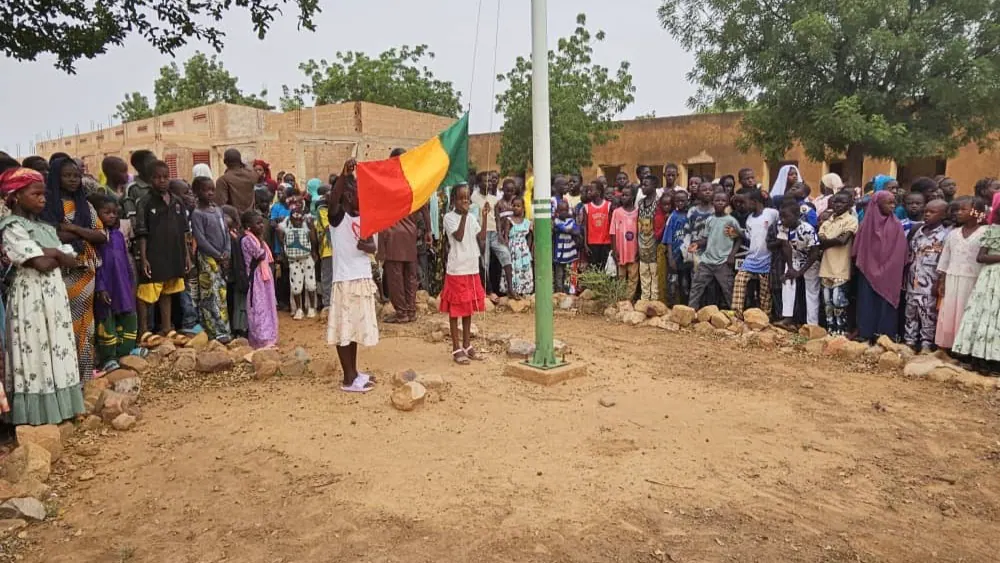
The UNICEF has reaffirmed its commitment to supporting the Malian government in providing quality education in a safe, healthy, and inclusive environment for the 2026-2027 school year. This year's model lesson focuses on food safety in schools, emphasizing that children learn better in an environment that protects their health, well-being, and development. The UNICEF and its partners have made significant progress in supporting education in Mali.
In the past year, 151,189 children received school kits and educational materials, while 2,562 teachers were trained in various disciplines, and 589 classrooms were constructed or rehabilitated. The UNICEF also supported the construction of menstrual hygiene facilities in 79 schools and the construction and rehabilitation of latrines and water points for 35,585 students. These interventions aim to strengthen access to quality education in safe, inclusive, and protective learning environments.
Despite these advances, over 2 million children remain out of school or at risk of dropping out, and 2,444 schools are non-functional, affecting over 733,000 children and nearly 14,700 teachers. The Malian Minister of National Education, Dr. Amadou Sy Savane, emphasized that the 2026-2027 period has been declared the year of education and culture, reflecting the vision and commitment of Mali's highest authorities.
Dr. Amadou Sy Savane stated that the goal is to translate this vision into concrete actions and sustainable results through the mobilization of the entire educational community. For many children in Mali, school represents more than just a place of learning; it is a space for protection, socialization, and hope. A school with a healthy environment, clean water, adequate sanitation facilities, and safe food practices contributes to improving learning outcomes and strengthening students' health and well-being.
The Coordinator of the United Nations System in Mali, Mme. Hanaa Fikry Ahmed Singer, highlighted that prioritizing education and culture is an investment in Mali's future. She emphasized that every child who learns, every girl who stays in school, and every teacher supported is a concrete step towards a stronger Mali. The United Nations will continue to support the government and communities to ensure that more children can learn, grow in security, and build their future in Mali.
The UNICEF Representative in Mali, Mr. Mohammad Fayyazi, recalled that children need more than just a classroom to learn and succeed; they need access to water, health, nutrition, and protection. The UNICEF will continue to support the Malian government in promoting access to quality education, school retention for the most vulnerable children, and improved learning conditions through integrated interventions in education, nutrition, water, hygiene, sanitation, and child protection.
As the new school year begins, the UNICEF is urging authorities, partners, communities, and families to continue investing in education, nutrition, water, sanitation, and child protection. The organization emphasizes that every child has aspirations for their future, and this school year is an opportunity to highlight their expectations and vision for a safe, inclusive, and quality school where every girl and boy can learn, grow, and develop their full potential.
Key points
- The UNICEF has supported the construction of menstrual hygiene facilities in 79 schools and the construction and rehabilitation of latrines and water points for 35,585 students in Mali.
- Over 2 million children remain out of school or at risk of dropping out in Mali, and 2,444 schools are non-functional.
- The UNICEF is working with the Malian government to promote access to quality education, school retention for the most vulnerable children, and improved learning conditions.