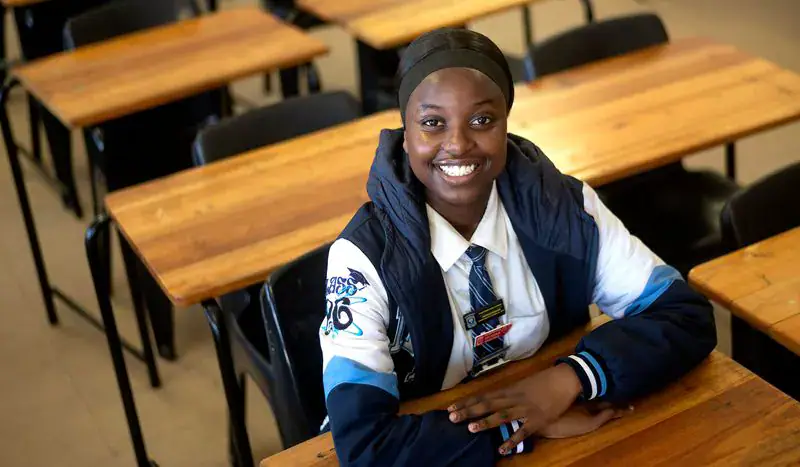
As the National Senior Certificate (NSC) exams approach, many learners in South Africa are preparing for a stressful experience. However, undocumented learners face additional burdens, including the obstacles to proceeding from school to higher education. Mufaro Marufu, a Grade 12 learner, believes she will do well in her exams, but her future is uncertain due to her undocumented status. Her parents immigrated to South Africa when she was young, and she has never left.
The surge in xenophobic violence has also affected learners, with some being forced to leave their schools and homes. Blessing Kachere, a Malawian learner, was separated from his parents during a mob attack in Masakhane, Western Cape. He eventually found his way to his school, but his parents were unable to enroll him due to his lack of documentation. The family later returned to Malawi, and Blessing's education was disrupted.
The Zimbabwe Exemption Permit Coordinating Committee reported that 99 learners had made contact, fearing they would not be able to write exams due to anti-migrant unrest. The Department of Basic Education confirmed that 76 of these learners were registered for the National Senior Certificate and would write their exams at their registered centers. However, the permit coordinating committee claims that many learners have not been assisted and face the prospect of never attaining their National Senior Certificate.
Learners who miss exams due to circumstances beyond their control must make an affidavit at their nearest police station and notify the Department of Basic Education. However, it is unclear whether the department will accept displacement due to violence as a valid justification for writing supplementary exams. Human rights attorney Liesl Fourie notes that this is something that still needs to be tested.
Many learners are struggling to secure necessary documents, including a valid immigration document, passport, and birth certificate. Mufaro Marufu had to travel to Zimbabwe to apply for documents, causing her to miss most of a school term. Her friend Michael Bakili also traveled to the Democratic Republic of Congo to apply for a birth certificate, which was a costly and time-consuming process.
Schools are required to request documents, but making such requests without emphasizing that learners can still register for and write their National Senior Certificate without producing documents is problematic. Zeenat Sujee, Head of the Education Rights Programme at SECTION27, notes that the Phakamisa judgment of 2019 permits undocumented learners to enroll at schools and write their matric exams.
The Department of Basic Education has confirmed that undocumented learners cannot be prevented from registering and writing the National Senior Certificate examination. Umalusi, South Africa's education quality council, has also confirmed that an identity document is not required for learners to write their matric exams. Despite this, many undocumented learners continue to face challenges in pursuing their education.
Key points
- Undocumented learners in South Africa face significant challenges in pursuing higher education due to xenophobia, paperwork, and lack of necessary documents.
- The Department of Basic Education has confirmed that undocumented learners cannot be prevented from registering and writing the National Senior Certificate examination.
- Learners who miss exams due to circumstances beyond their control must make an affidavit at their nearest police station and notify the Department of Basic Education.