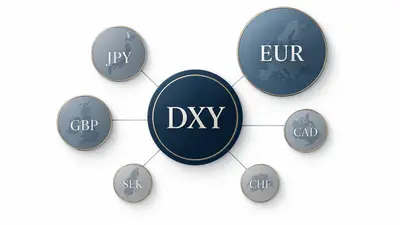
The US Dollar Index, commonly referred to as DXY, is a market indicator that measures the strength of the US dollar against a select group of currencies. It is administered by ICE and has been in use since 1973. The index is widely followed in the financial markets, but its composition is not widely understood. DXY does not measure the dollar's strength against every major currency, and it does not include the South African rand.
The DXY index tracks the dollar against a fixed basket of six currencies, with the euro making up more than half of the basket. The euro's weighting is 57.6%, which is larger than the combined weight of the other five currencies. The six currencies in the basket are the euro, Japanese yen, British pound, Canadian dollar, Swedish krona, and Swiss franc. This composition has changed only once, in 1999, when the euro replaced several legacy European currencies.
The weighting of the currencies in the DXY basket is based on a fixed formula that reflects quote conventions. The euro and British pound enter the formula inversely, while the other four currencies move in the same direction as the dollar. This means that a significant move in the EUR/USD exchange rate can have a large impact on the DXY index. As a result, EUR/USD often has the biggest influence on moves in the index.
The relationship between EUR/USD and DXY is not a perfect inverse relationship, and the other five currencies in the basket still matter. The DXY index can be influenced by central bank decisions, major economic data releases, and risk-off moves in the financial markets. While EUR/USD often moves in the opposite direction of DXY, this is not always the case.
One of the limitations of the DXY index is that it does not provide a complete measure of global dollar strength. The index does not include several major currencies, such as the Chinese yuan, Indian rupee, Mexican peso, Brazilian real, and Australian dollar. This is particularly relevant for South African readers, as a rising DXY does not automatically mean that the USD/ZAR exchange rate will rise by the same amount or even move in the same direction.
The rand can be influenced by a range of factors, including commodity prices, local inflation, fiscal policy, electricity supply developments, and shifts in appetite for emerging market assets. For a broader trade-weighted measure of the dollar's strength, the US Federal Reserve maintains a broad dollar index that covers currencies from 26 economies. This index provides a more comprehensive picture of the dollar's performance in the global economy.
Despite its limitations, the DXY index remains widely used in market commentary due to its long history and widespread trading. The index can be followed as a benchmark, traded through exchange-listed futures, or accessed through derivatives such as CFDs. Traders need to be aware of the costs associated with trading DXY, including spreads, commissions, overnight financing, and execution conditions.
Key points
- The DXY index tracks the dollar against a fixed basket of six currencies, with the euro making up more than half of the basket.
- The index does not provide a complete measure of global dollar strength, as it does not include several major currencies.
- The DXY index remains widely used in market commentary due to its long history and widespread trading.