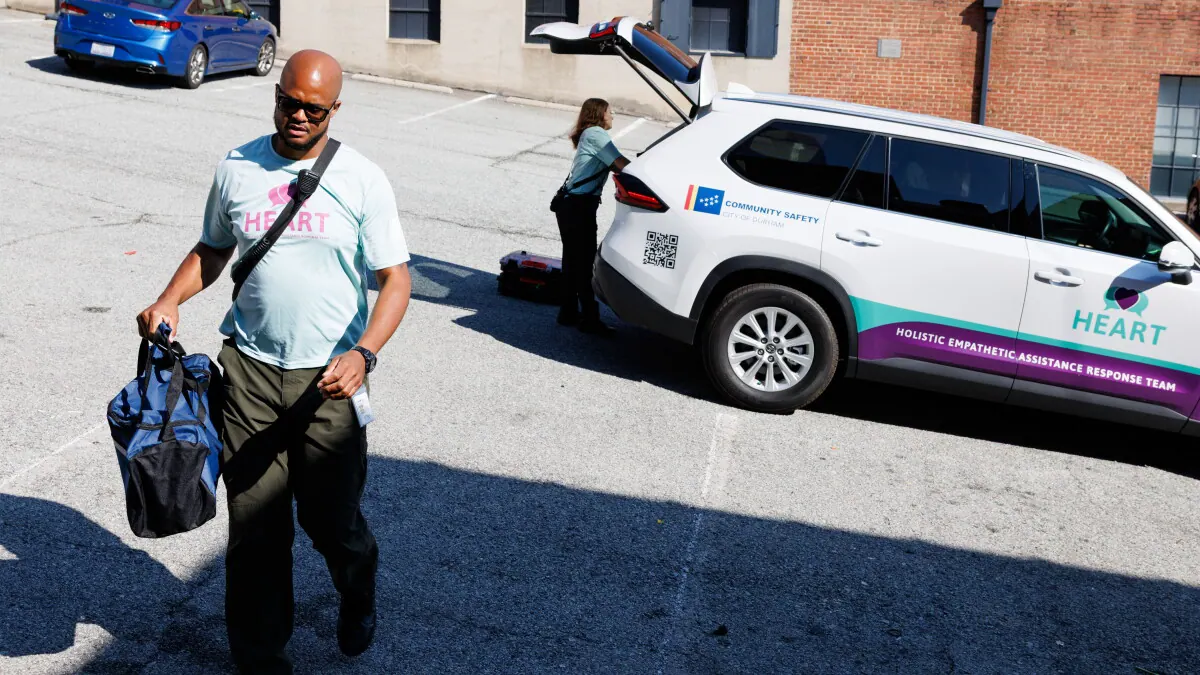
In Durham, North Carolina, an unarmed community response team called the Holistic Empathetic Assistance Response Team (HEART) has responded to over 25,000 911 calls since its launch in 2022. The team, made up of mental health clinicians and peer support specialists, is equipped with snacks, bottled water, and hygiene kits to help de-escalate situations. On a recent Wednesday, team members Rob Crisp and Allie Craft responded to a 911 call about a trespasser on a business property. They found the man, who was tense and had several belongings with him, and after a few minutes of conversation, calmed him down and provided him with water and a fresh pair of socks.
The concept of unarmed community response teams is gaining traction across the US, with nearly 100 cities now having such programs in place. This represents a significant increase from 2020, when there were only six programs in the country. The teams are designed to respond to certain 911 calls that do not require an armed officer, such as mental health crises or homelessness situations. By sending unarmed responders, cities aim to reduce the risk of escalation and provide more effective support to those in need.
Research suggests that these programs are showing signs of success. A preliminary study from Duke University found that Durham's HEART program has increased 911 calls, a potential sign of growing public trust. Another study by the Research Triangle Institute found that the program is associated with fewer arrests, and that most police officers find it helpful. Similar studies in other cities, such as Denver and Eugene, Oregon, have also found positive results.
Despite the promising results, implementing these programs can be challenging. In Durham, police officers initially had concerns about the program, worrying that they would have to protect the unarmed responders. However, over time, officers began to accept the program as a valuable part of the public safety team. The city's former police chief, Patrice Andrews, helped launch HEART and says that having police and HEART on the same radio channel for dispatch has been key to its success.
One of the key questions surrounding these programs is how many 911 calls they can handle. In some cities, fatal police shootings have raised questions about the limitations of alternative response programs. In New York City, for example, an audit found that the majority of the city did not have access to its program. In Baltimore, the number of 911 calls diverted to mental health services had fallen by over 50% in recent years.
Experts say that one way to measure the success of these programs is to assess how many 911 calls they handle per capita. Durham's HEART program, for example, handles around 28 calls per 1,000 residents, according to the Law Enforcement Action Partnership. However, researchers caution that it's hard to say what the ceiling is in terms of how many 911 calls these programs can safely take.
As the use of unarmed community response teams continues to grow, researchers and city officials are working to determine best practices and evaluate their effectiveness. While there are still many questions to be answered, the early results suggest that these programs can be a valuable part of the public safety net, providing critical support to those in need while also helping to reduce the risk of escalation and promote community trust.
Key points
- Unarmed community response teams are being dispatched to 911 calls in nearly 100 US cities, providing an alternative to police officers in certain situations.
- Research suggests that these programs are showing signs of success, including increased 911 calls and fewer arrests.
- Experts say that one way to measure the success of these programs is to assess how many 911 calls they handle per capita.