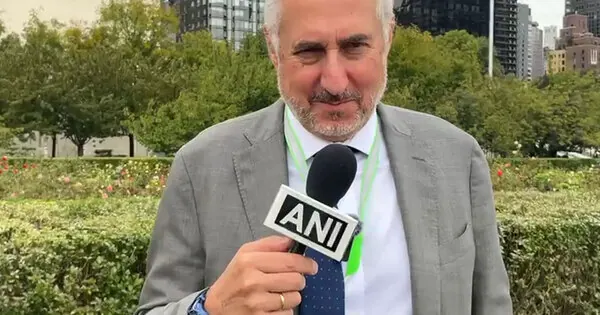
The state of global multilateral governance was a central theme during the high-level United Nations General Assembly week. Top American and United Nations officials weighed in on international conflicts, institutional efficacy, and sovereign priorities. Stephane Dujarric, spokesperson for UN Secretary-General Antonio Guterres, addressed the organisation's role in maintaining global peace and security. He stated that the UN's effectiveness is directly tied to the commitment of its member states.
Dujarric responded to criticisms surrounding multilateral institutions, emphasising that the UN's strength is contingent upon the collective commitment of its member states. He drew a parallel with a statement made by former US ambassador Richard Holbrooke, suggesting that the UN's performance cannot be blamed if its member states do not uphold their responsibilities. Dujarric stressed that it is up to the member states to recommit to diplomacy, international law, and limiting the use of power within the framework of international law.
These remarks were made in response to statements by US Secretary of State Marco Rubio, who asserted that a functional international system is needed to manage global disputes. Rubio pointed to several conflicts, including those between Thailand and Cambodia, India and Pakistan, and the situations in the Democratic Republic of Congo, Rwanda, Sudan, and Iran. He noted that many global leaders share the view that current multilateral mechanisms are falling short.
Rubio stated that the international system has grown beyond its mandate and is unable to solve major conflicts. He emphasised that without a functional international system, individual nations will continue to act according to their sovereign priorities. The top US diplomat clarified that his comments were not an attack on the international system but rather an acknowledgment of its limitations.
Rubio further emphasised that the US will always act in its national interest, not in the interest of the international order. He stated that the US will never put the international order above its own interests. These comments followed recent addresses at the UN General Assembly, where US leadership touched upon international conflicts.
The debate over the state of global multilateral governance highlights the complexities of international relations and the challenges faced by multilateral institutions. The UN's role in maintaining global peace and security is widely acknowledged, but its effectiveness is often hindered by the competing interests of its member states.
The discussions at the UN General Assembly underscore the need for a more effective international system that can address the complex challenges facing the world today. The commitment of member states to diplomacy, international law, and collective action will be crucial in determining the future of global governance.
Key points
- The UN's strength in global governance is contingent upon the collective commitment of its member states.
- The international system has grown beyond its mandate and is struggling to address major conflicts.
- The US will prioritise its national interest over the international order.