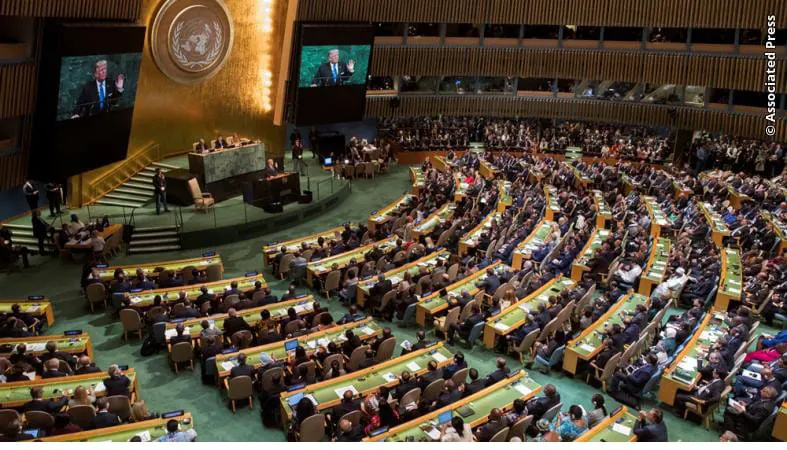
The 81st General Assembly of the United Nations has highlighted the growing demands from the Global South for a more equitable world order. World leaders gathered at the UN headquarters, reflecting on the organization's 78-year history and its founding principles. The UN Charter, signed on October 24, 1945, pledged to "save succeeding generations from the scourge of war" and uphold "the equal rights of men and women and of nations large and small." However, many argue that these principles have not been upheld.
The UN's achievements, such as preventing a third world war, providing a forum for dialogue during the Cold War, and giving the world the Universal Declaration of Human Rights, are notable. The World Health Organization eradicated smallpox, and UNICEF saved millions of children. However, the organization's architecture has been criticized for being flawed from the start. The Security Council's veto power, held by five nations – the United States, the United Kingdom, France, Russia, and China – has been a contentious issue.
The veto power has allowed these nations to block resolutions, often shielding themselves from accountability. This has led to catastrophic consequences, including in Rwanda, where nearly a million people were slaughtered in 1994, and in Syria, where Russia has vetoed resolutions while the Assad regime has committed atrocities. African and Global South leaders argue that this has resulted in a disproportionate impact on their regions.
President Luiz Inácio Lula da Silva of Brazil addressed the General Assembly, warning that the UN was drifting towards "irrelevance" due to the paralysis of the Security Council. He denounced the current state of affairs as "unacceptable" and emphasized that the world has changed significantly since 1945. Lula da Silva called for a global financial architecture that prioritizes people over profit and presented a Brazilian initiative on climate change.
African leaders also made their voices heard at the General Assembly. President William Ruto of Kenya emphasized that Africa, with over 1.4 billion people, is the only major region without permanent representation on the Security Council. He argued that this is a matter of justice and equity, and that Africa deserves a permanent voice in decisions that shape its own peace. President Nana Akufo-Addo of Ghana reinforced this point, calling for a global order built on justice, equity, and mutual respect.
Vice President Kashim Shettima of Nigeria, speaking on behalf of President Bola Ahmed Tinubu, argued that no single nation can solve global challenges like climate change, terrorism, or economic inequality alone. He emphasized that multilateralism must be renewed, but that cooperation must rest on equity, not the perpetuation of an unjust order. Shettima also pressed Africa's case for a permanent seat on the Security Council and spoke about the importance of democracy and good governance.
The Prime Minister of Niger, Ali Mahamane Lamine Zeine, delivered a defiant address, asserting Niger's sovereignty and control over its resources. He announced that Niger had recovered control of its uranium production and declared that the resource belongs exclusively to Niger. Zeine accused France and Ukraine of complicity in destabilizing the Sahel region, arguing that the conflict is part of an attempt to regain control over African resources.
Key points
- The Global South is demanding reforms to the UN Security Council, including the expansion of permanent seats to include more representative members.
- African leaders are calling for a more equitable global order, with a focus on justice, equity, and mutual respect.
- The UN's veto system has been criticized for allowing powerful nations to shield themselves from accountability, leading to catastrophic consequences.