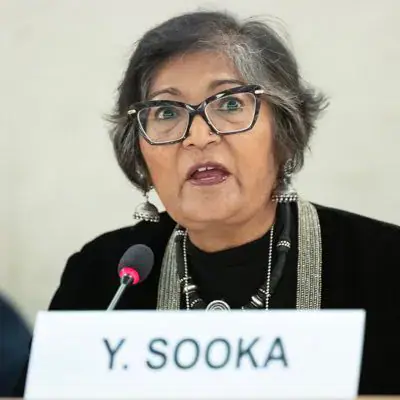
The United Nations Commission on Human Rights in South Sudan has urged the international community to take immediate action to prevent renewed conflict and protect the country's fragile political transition. Commission Chair Yasmin Sooka warned that key safeguards established under the 2018 peace agreement are being systematically dismantled. Sooka emphasized that South Sudanese have the right to choose their leaders, but elections must be conducted freely and without fear.
Sooka addressed the UN General Assembly's Third Committee, highlighting concerns over recent political and constitutional developments in South Sudan. She noted that the country's electoral process should not be used to justify weakening provisions of the 2018 Revitalized Agreement on the Resolution of the Conflict in South Sudan. These provisions include inclusive governance, power-sharing, political participation, and institutional oversight. Sooka described the development as a concentration of political authority in the presidency.
The Commission expressed concern over the detention and trial of First Vice President Riek Machar and restrictions faced by his party and other opposition actors in the electoral process. Commissioner Barney Afako stated that South Sudan's central challenge is not simply whether elections take place on a particular date, but whether the country can establish a credible political process capable of resolving grievances and managing political differences peacefully.
The Commission warned that continued fighting, the presence of armed forces outside a unified command, and persistent impunity are increasing the risk of renewed conflict. It raised particular concern about fighting in Upper Nile and Jonglei, attacks on civilian infrastructure, conflict-related sexual violence, and the recruitment of children by armed groups. The Commission called on the African Union to take concrete steps towards establishing the Hybrid Court for South Sudan.
Commissioner Carlos Castresana Fernández emphasized that impunity remains a major obstacle to sustainable peace, with individuals accused of serious violations continuing to hold senior political and military positions. The Commission further called for action against resources that fuel conflict, including arms transfers, conflict financing, and the diversion of public revenues. It urged the African Union, the Intergovernmental Authority on Development (IGAD), and the United Nations to activate a joint task force.
The Commission called for an immediate cessation of hostilities, protection of civilians, and safe and unhindered humanitarian access. It urged member states to provide the UN Mission in South Sudan (UNMISS) with the resources and freedom of movement needed to protect civilians, strengthen early-warning mechanisms, and support reconciliation. The Commission also emphasized the need for independently assessed safeguards, credible voter registration, and participation of refugees and internally displaced people in the electoral process.
The Commission's independent members were in New York from 26 to 30 October for consultations with UN member states, regional partners, civil society, and other stakeholders on measures to prevent further deterioration in South Sudan. Sooka warned that the opportunity to prevent wider atrocities is narrowing and called for coordinated international action to keep the country's path toward sustainable peace open.
Key points
- The UN Commission on Human Rights in South Sudan warns that key safeguards established under the 2018 peace agreement are being systematically dismantled.
- The Commission calls for urgent international action to prevent renewed conflict and protect the country's fragile political transition.
- The Commission emphasizes the need for an inclusive political settlement, regardless of whether elections are held as scheduled.