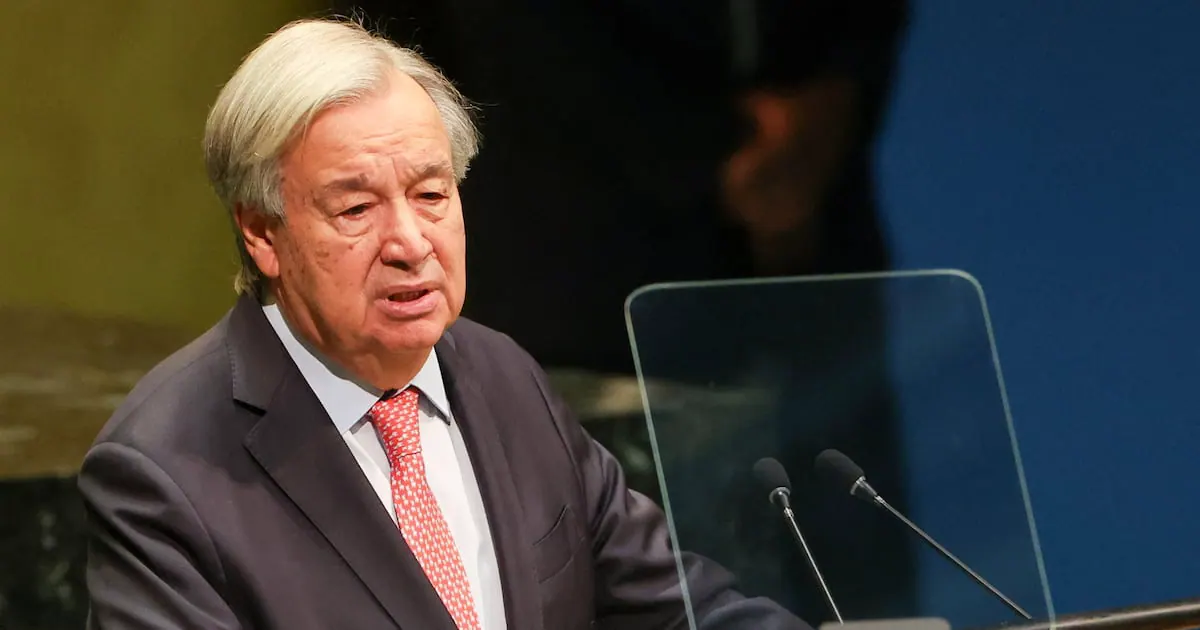
UN Secretary-General António Guterres has urged global leaders to regulate artificial intelligence, end wars, focus on climate change, and overhaul UN institutions in his final address to the General Assembly. Guterres, whose second five-year term ends on December 31, emphasized the need for global oversight of AI risks as the UN's 15-member Security Council prepares to host AI leaders for a briefing on the technology. He also reflected on the gridlock within the organisation, with nearly 130 world leaders gathering in New York.
Guterres reiterated his calls for global governance of AI, stressing that countries leading the technological revolution must share information on emerging safety risks and work towards common safeguards. He proposed a multilateral AI risk management framework, supported by credible and independent oversight. The UN created a 39-member advisory body on AI in 2023, with members including tech company executives, government officials, and academics from countries such as the US, Russia, and Japan.
The Security Council met for the first time on the risks of AI in 2023, with China warning that the technology should not become a "runaway horse" and Washington cautioning against its use to censor or repress people. Guterres also called for de-escalation and dialogue in the Middle East, where the conflict has widened, threatening shipping routes and tensions persist in the Strait of Hormuz. He demanded that "polluters must pay" for climate change and pressed for reforms to international institutions.
Guterres defended a two-state solution for Israelis and Palestinians, which was met with sustained applause from delegates. He also bid farewell to most of the global leaders he has worked with over the past 10 years, saying that he will continue to champion the conviction that peace is possible. Guterres has sought to position the UN as a mediator in conflicts and a forum for governing emerging technologies, even as major powers increasingly bypassed the organisation and Washington slashed its funding.
The US treasury secretary, Scott Bessent, announced on Sunday that Washington had proposed a new AI safety notification mechanism for US President Donald Trump and Chinese President Xi Jinping to consider at their summit. The proposal emerged from talks on establishing a US-China AI dialogue and would cover AI-related incidents with national security implications. Guterres has long pushed for global governance of AI, warning of the risks associated with the technology.
Guterres criticised the current UN system, saying that its mechanisms for collective action are under growing strain and global institutions "continue to reflect the power realities and interests of a largely bygone age". He called for reforms to international institutions, which he has championed throughout his decade leading the UN. The address capped a decade-long tenure in which Guterres sought to position the UN as a mediator in conflicts and a forum for governing emerging technologies.
Guterres concluded his address by saying that he will keep championing the values of the United Nations Charter and will never give up. He will step down as secretary-general on January 1, but will continue to advocate for peace and global cooperation. The UN will need to adapt to the changing global landscape, with many challenges ahead, including the regulation of AI, climate change, and conflicts around the world.
Key points
- Guterres urges global leaders to regulate AI risks
- UN Secretary-General calls for reforms to international institutions
- Guterres defends a two-state solution for Israelis and Palestinians