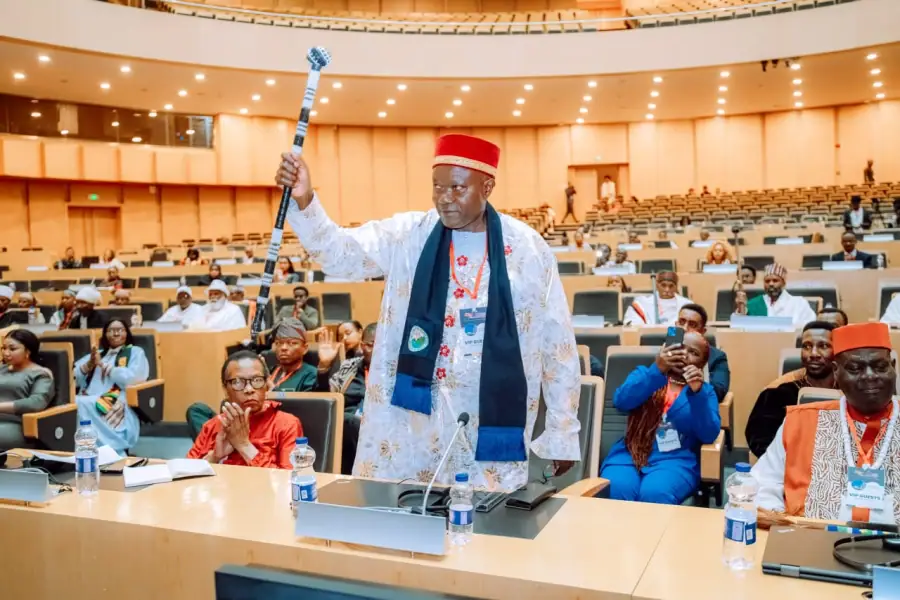
His Royal Highness Sir Jude Mike Mudoma III, the Umukuuka wa Bugisu, has proposed the establishment of a Traditional Leaders' Apex Body and a Regional House of Kings across Africa. This initiative aims to strengthen cultural cooperation, promote peace, and improve governance on the continent. Mudoma made this proposal at the African Traditional Leaders Conference held at the African Union Headquarters in Addis Ababa, Ethiopia, from November 10 to 15, 2026.
The conference, themed "African Culture, Indigenous Knowledge Systems (IKS), and Natural Resources," focused on the topic "Culture is a Foundation for Peace and Governance." Mudoma emphasized that Africa's efforts to achieve lasting peace and self-reliance must be rooted in its indigenous cultural values. He argued that formal state governance structures are often disconnected from cultural realities and indigenous systems, leading to challenges in many African countries.
Mudoma urged African governments to recognize traditional institutions as important partners in governance, environmental conservation, conflict resolution, and sustainable development. He cited examples from across Africa, such as the Shona and Ndebele communities in Zimbabwe, where traditional practices have helped protect water catchment areas and biodiversity. He also mentioned the Kaya forests of Kenya's Mijikenda communities, where traditional councils of elders have played a role in protecting forests and managing natural resources.
The Umukuuka highlighted the importance of incorporating indigenous practices into contemporary government policies. He explained that traditional knowledge can contribute to climate resilience, environmental protection, and sustainable resource management. Mudoma also proposed integrating clan-based mediation structures into national judicial systems to strengthen access to justice and resolve community disputes.
Mudoma suggested that traditional justice mechanisms can provide restorative solutions to local disputes, particularly where adversarial court processes may be inaccessible or alienate grassroots communities. He emphasized that cultural leadership promotes consensus-building and reconciliation, helping communities resolve disagreements without deepening social divisions.
To preserve indigenous knowledge and professional experience, Mudoma proposed a new framework called "State Technical Guardianship." This initiative would recognize retired professionals, elders, and holders of specialized technical knowledge as institutional guardians responsible for mentoring young people and preserving valuable expertise. He suggested that the initiative could be coordinated through government ministries responsible for social development.
Mudoma also emphasized the importance of involving cultural institutions in environmental protection and disaster management. He highlighted the devastating effects of landslides on communities living along the slopes of Mount Elgon and stressed that environmental protection and disaster management cannot depend entirely on government directives without meaningful community participation.
Key points
- Mudoma proposes the establishment of a Traditional Leaders' Apex Body and a Regional House of Kings to promote peace, governance, and cultural cooperation across Africa.
- He emphasizes the importance of incorporating indigenous practices into contemporary government policies to contribute to climate resilience, environmental protection, and sustainable resource management.
- Mudoma suggests a "State Technical Guardianship" framework to preserve indigenous knowledge and professional experience.
Reporting sources
- Umukuuka Mudoma Pushes for African House... · nilechronicles.com