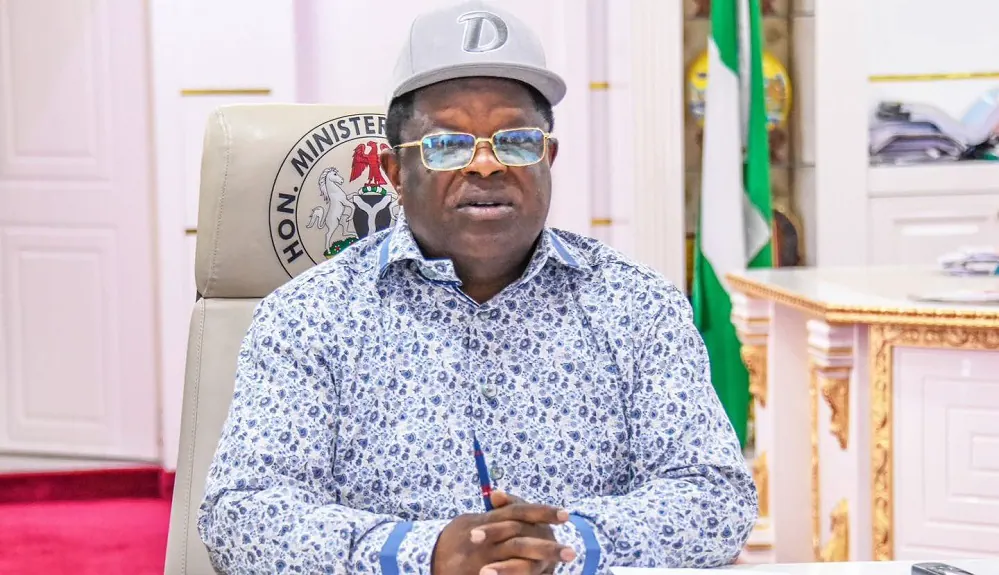
Nigeria's Minister of Works, David Umahi, has defended the financing of the Federal Government's legacy road projects, saying the loans are investment-driven and will be repaid through tolling and commercial developments along the corridors. Umahi stated that external financiers are funding 70 percent of the projects, while the Federal Government will provide the remaining 30 percent. He described the loans as investments with a return on investment.
Umahi cited the Lagos-Calabar Coastal Highway as an example, saying five companies have indicated interest in taking over the completed first section and paying the government for its investment. He argued that the infrastructure will stimulate economic activity and improve security. The Minister said the financing and procurement processes have passed through relevant government institutions, including the National Assembly and the Federal Executive Council.
The Minister defended the Lagos-Calabar Coastal Highway against criticism over flooding, saying the highway itself has not been flooded and that the corridor has been prone to flooding decades before construction began. Umahi said studies showed that the highway had to be constructed above the existing flood level because the coastal terrain has historically been vulnerable to flooding.
According to Umahi, the 47.47-kilometre first section of the Lagos-Calabar Coastal Highway is being constructed with service lanes and five-foot drainage channels on both sides, with culverts to convey water across the highway into Lagos State drainage channels and ultimately the lagoon. He said the government is addressing flooding affecting properties along the corridor through new drainage infrastructure.
Umahi said the highway has a projected lifespan of between 50 and 100 years, with relatively low maintenance requirements. He also provided updates on other projects, including the Sokoto-Badagry Superhighway, saying the first 120-kilometre section in Sokoto is about 60 percent complete, while the 258-kilometre Kebbi section has exceeded 40 percent completion.
The Minister put the costs of the Sokoto-Badagry Superhighway sections at about N454 billion and N958 billion respectively, with completion of both sections targeted for the end of next year. He also defended the reconfiguration of some NNPC tax-credit projects, including the Abuja-Lokoja corridor, following President Bola Tinubu's directive that revenues should be returned to the Federation Account.
Umahi said Nigeria will continue to require borrowing to address its infrastructure deficit, arguing that improved roads will generate economic returns beyond their immediate transport functions. He maintained that subsidy savings have helped prevent a deeper economic crisis and urged Nigerians to assess the administration's performance against the economic conditions it inherited in 2023.
Key points
- The loans for the legacy road projects are investment-driven and will be repaid through tolling and commercial developments.
- The Lagos-Calabar Coastal Highway has not been flooded, despite criticism, and has a projected lifespan of 50-100 years.
- Nigeria will continue to require borrowing to address its infrastructure deficit, but improved roads will generate economic returns.