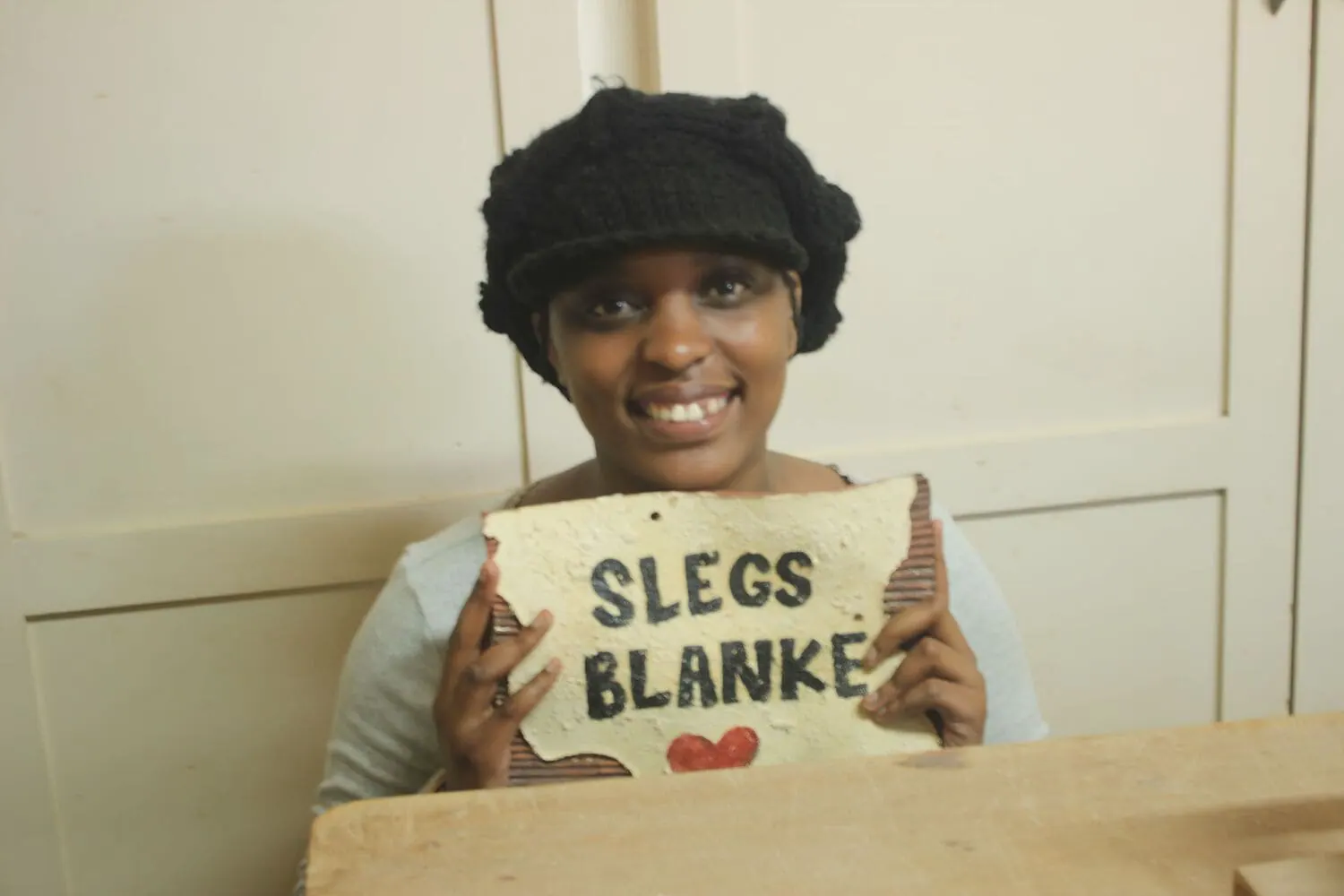
Lethabo Lengwati, a talented ceramicist, is currently the artist-in-residence at the Centre for Visual Arts at the University of KwaZulu-Natal in Pietermaritzburg. Her work offers a satirical exploration of humanity's need for belief, drawing inspiration from the proliferation of spiritual advertisements and miracle-working pamphlets that populate public spaces across Pietermaritzburg. Lengwati's residency, which comes to an end this month, has enabled her to create thought-provoking works that critique the relationship between the public and 'miracle workers' and products.
Lengwati's works, which include tiles, cups, and plates, may seem simple at first glance, but they are, in fact, complex and multi-layered. She uses these objects as a foundation to create works that speak to the viewer, critiquing the relationship between the public and those who claim to offer solutions to seemingly impossible problems. By translating the messaging of spiritual advertisements into actual products, Lengwati's works probe and target people's desires, hopes, and despairs. Her art is both playful and vulnerable, often incorporating witty humour and subtle critiques of the modern world.
The complexity and elemental nature of ceramic art are what appeal to Lengwati. She enjoys the physical motion of building something up, throwing a piece, or sculpting onto a piece. The process of creating glazes and seeing what chemical reactions work best also appeals to her scientific side. Unlike other institutions in South Africa, the University of KwaZulu-Natal allows students to make things from scratch, giving Lengwati the opportunity to experiment and test her theories.
Lengwati's background and upbringing have had a significant influence on her art. Growing up in Alexandra township in Gauteng, she admits that she did consider studying a science degree, which would have given her better job prospects. However, she ultimately chose to pursue her passion for art, which she believes has allowed her to express herself in a unique and meaningful way. Lengwati's love for making things and creating art has been a lifelong passion, and she is grateful to have had the opportunity to develop her skills.
During her residency, Lengwati shared her knowledge and love for ceramics with others in a plate-painting workshop. She believes that art is an essential part of human expression and that it has the power to bring people together. Lengwati's works often incorporate elements of South Africa's not-so-distant, racially segregated past, and she hopes that her art will continue to inspire and challenge viewers.
Looking ahead, Lengwati plans to return home and explore ways to help future young artists in her township. She is aware that funding may be a challenge, but she believes that with creativity and determination, it is possible to establish successful art programs. Lengwati hopes to run workshops and provide opportunities for children to express themselves through art, which she believes is essential for their emotional and psychological well-being.
Lengwati's residency at the University of KwaZulu-Natal has been a valuable experience, and she is grateful for the opportunity to have shared her art with others. Her works will continue to inspire and challenge viewers, offering a unique perspective on humanity's need for belief. As she looks to the future, Lengwati remains committed to her art and her passion for helping others.
Key points
- Lethabo Lengwati's satirical works critique the relationship between the public and 'miracle workers' and products.
- Her art incorporates elements of South Africa's not-so-distant, racially segregated past.
- Lengwati plans to establish art programs for children in her township, despite potential funding challenges.