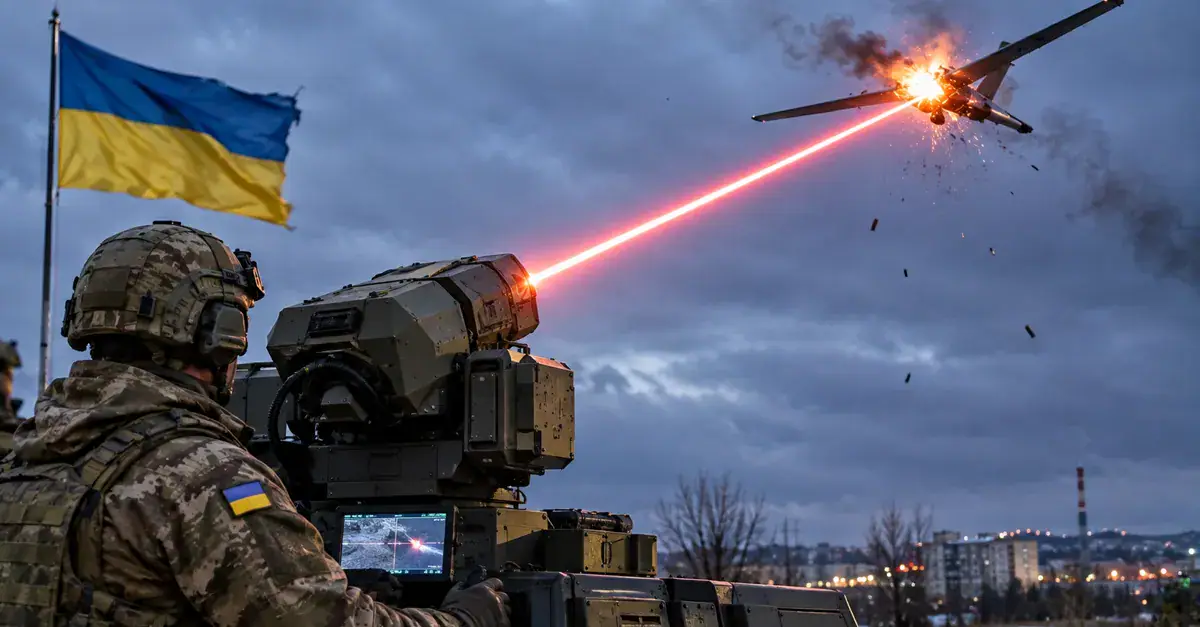
Ukraine has successfully used a ground-based laser weapon to down a Russian drone for the first time in modern warfare, marking a significant shift in the escalating drone battle on the front lines. According to a report by The Telegraph, citing a senior military adviser to President Volodymyr Zelensky, the Ukrainian laser defense system, "Blysk," developed by Carminsky Air, tracked and downed a Russian "Geran" jet-powered drone near a vital infrastructure site. The laser locked onto the drone's structure, setting it ablaze within seconds.
The historic achievement was announced by Serhiy Piskristynov, senior military adviser to Zelensky, via Telegram, stating it was "the first operation of its kind in the world." The development of "Blysk" is part of the government program "Special Air Defense" supported by Brave1, a defense technology coalition that includes nearly 100 Ukrainian companies. This breakthrough comes as Ukraine faces a significant shortage of intercept missiles due to ongoing Russian strikes on cities and infrastructure.
Despite the success, The Telegraph reports that the "Blysk" system is still in testing, with a limited capacity of four kilowatts and a range of just half a mile, making it far inferior to its international counterparts. Weather conditions like clouds and fog delayed the first real test, although it has been deployed as part of Kyiv's air defense system since early November. Piskristynov acknowledged that it's still early to discuss mass production of these systems.
This development is crucial for Ukraine, which is struggling with a substantial shortage of American Patriot missiles, according to Zelensky. He warned that delays in supplies "cost the lives of Ukrainians" and expressed disappointment that Western attention has shifted towards the Middle East. In this context, laser technology emerges as an attractive alternative; it operates on electricity, not expensive ammunition, and can be reused countless times, unlike missiles that are consumed with a single strike.
Ukraine is not alone in pursuing this technology, as the UK's Ministry of Defence has announced a £20 million investment in developing anti-drone lasers to support the DragonFire system, set to be installed on Royal Navy destroyers starting in 2027. This indicates that directed-energy weapons are becoming a strategic rather than tactical bet. The use of laser technology in modern warfare is gaining traction as a cost-effective solution.
The "Blysk" system offers a promising solution for Ukraine, which has been facing significant challenges in defending against Russian drone attacks. The use of laser technology could potentially level the playing field and provide Ukraine with a much-needed advantage on the battlefield. As the conflict continues, the development and deployment of such systems will likely play a critical role in shaping the future of modern warfare.
The implications of this technology extend beyond Ukraine, as it could potentially be used by other countries to counter drone threats. The development of directed-energy weapons is a rapidly evolving field, with significant investments being made by countries around the world. As this technology continues to advance, it is likely to have a profound impact on the nature of modern warfare.
Key points
- Ukraine's use of laser technology to down a Russian drone marks a significant shift in modern warfare dynamics.
- The "Blysk" system, developed by Ukraine, offers a cost-effective solution for countering drone threats.
- The development and deployment of directed-energy weapons are becoming a strategic priority for countries around the world.
Reporting sources
- أرخص من الصواريخ.. أوكرانيا تستخدم الليزر لإسقاط مسيرات روسيا · Al-Qahera News