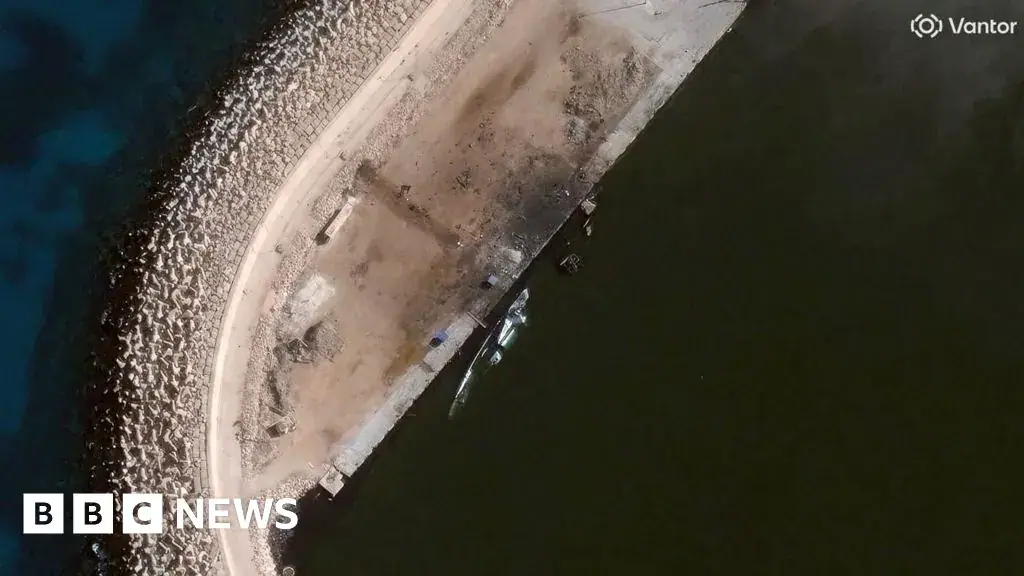
A recent nighttime attack on a Russian corvette, the Merkury, in Benghazi, Libya, has raised concerns about the spread of the Ukraine war beyond its borders. The attack, coordinated by Ukraine's SBU intelligence agency and its armed forces, was described by Ukraine's President Volodymyr Zelensky as "an exemplary operation." The Merkury was anchored in a Mediterranean harbor nearly 2,000 miles from Moscow, and its captain may have thought it was safe from attack.
The attack on the Merkury has been condemned by Russia as "a dangerous escalation." It follows a suspected Ukrainian drone attack on a Russian dry-cargo ship in the Gulf of Finland, which the Kremlin described as an act of terrorism. Ukraine's long-range drones have also previously struck Russia's Baltic oil terminal at Ust-Luga. These attacks demonstrate Ukraine's ability to plan and execute bold operations far from its borders.
This is not the first time Ukraine has carried out long-range drone attacks on Russian targets. Last year, Ukraine's Operation Spider's Web involved a specially adapted lorry that drove close to a Russian strategic nuclear bomber airbase and released a "swarm" of explosive drones that damaged or destroyed several expensive bombers. Ukraine has also targeted Russian mercenaries from the Africa Corps, the successor to the infamous Wagner Group, in Africa.
The United Nations mission in Libya has expressed "deep concern" over the attack on the Merkury. Libyan officials point out that their country is not a party to the Russia-Ukraine war, although the Merkury and an accompanying cargo ship were berthed in the eastern part of Libya controlled by the pro-Moscow warlord Khalifa Haftar. The International Maritime Organisation has condemned all attacks on commercial shipping in the Strait of Hormuz.
The attack on the Merkury has raised concerns about the potential for further attacks on commercial shipping. If Ukraine can plan and execute such a bold attack on Russian ships in a nominally neutral harbor, it raises questions about where this might stop. The global shipping community will be watching developments closely, and the incident may set a dangerous precedent.
The war in Ukraine has already been spreading to other parts of Europe. Recently, several Russian projectiles landed inside Poland's borders, just 60 miles from an Anglo-French exercise of forces intended to be deployed following an eventual ceasefire in Ukraine. Poland's Prime Minister, Donald Tusk, described this as "a deliberate provocation" by Moscow.
The Baltic states – Estonia, Latvia, and Lithuania – all have borders with Russia and consider themselves on the front lines in this war. There have been a number of anonymous attacks on military industrial facilities in these countries, blamed on agents acting on Moscow's behalf. Hybrid warfare, including cyber attacks and the dispatching of drones, is on the rise, with incidents reported in Germany, Poland, and the UK.
Key points
- The attack on the Merkury demonstrates Ukraine's ability to plan and execute bold operations far from its borders.
- The war in Ukraine has already been spreading to other parts of Europe, including Poland and the Baltic states.
- The incident may set a dangerous precedent for further attacks on commercial shipping.