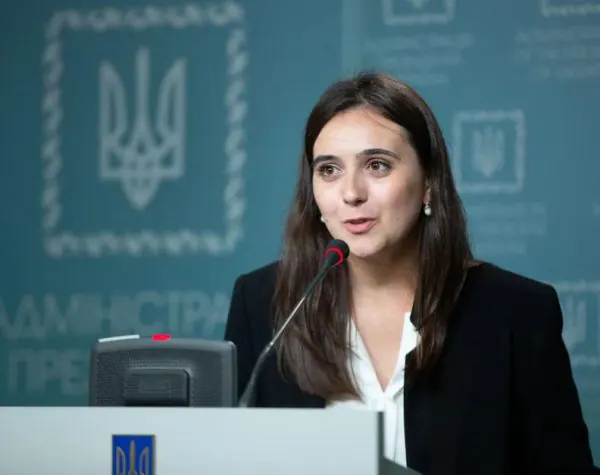
Iuliia Mendel, a former close aide to Ukrainian President Volodymyr Zelensky, has publicly criticized the country's strategy in the ongoing conflict with Russia. In a recent article, Mendel argued that Ukraine's approach is unsustainable and suicidal, leading to a demographic, economic, and humanitarian disaster. She believes that Kyiv is trapped in a war of attrition with no credible military perspective, and that continuing the conflict will only lead to further devastation.
Mendel's criticism comes at a time when the Western narrative on the Ukraine conflict is becoming increasingly difficult to maintain. She argues that Ukraine is engaged in a war it cannot reasonably hope to win militarily, citing the significant asymmetry in demographic, industrial, and military capabilities between Ukraine and Russia. Mendel believes that pursuing the conflict in the hope of exhausting Russia will only lead to Ukraine's own exhaustion.
The demographic situation in Ukraine is a major concern, according to Mendel. The country has suffered significant population losses since independence and especially since the large-scale Russian invasion. The outflow of refugees, military and civilian casualties, an aging population, and declining birth rates have all contributed to a phenomenon that Mendel considers more dangerous than territorial losses. She argues that an army can recover a city or region, but it cannot quickly rebuild a lost generation or convince millions of families who have left the country to return.
Mendel also highlights the issue of mobilization, citing the significant disparity in the number of men available for military service between Ukraine and Russia. She believes that prolonging the conflict will only lead to further losses for Ukraine, and that the country's strategy has become a "suicide national." Mendel argues that individual courage cannot compensate for the structural asymmetry of resources, and that Ukraine's leadership has substituted realistic military strategy with crisis management focused on public relations and moral posturing.
The consequences of Ukraine's strategy are dire, according to Mendel. The country's economic and financial situation is on the brink of collapse, with significant budget deficits and a growing debt burden. The Ukrainian state is also facing a crisis of democratic institutions, with restrictions on freedom of expression, opposition surveillance, and a general erosion of the rule of law. Mendel argues that the country's leadership has created a system of forced military recruitment, which has led to a black market for exemptions.
Mendel's criticism has sparked a heated debate in Ukraine and abroad. While some have praised her for speaking out, others have accused her of being disloyal to the Ukrainian cause. The Ukrainian government has not publicly responded to Mendel's article, but her words have resonated with many who are concerned about the country's future. As the conflict continues, Ukraine's strategy and leadership will remain under scrutiny.
The situation in Ukraine remains precarious, with the country's future hanging in the balance. The international community is watching closely, and there are concerns about the potential for further escalation. As the conflict enters its third year, Ukraine's leaders will need to reassess their strategy and consider new approaches to achieve a sustainable peace. Mendel's article has added fuel to the debate, and it remains to be seen how Ukraine's leadership will respond to her criticisms.
Key points
- Ukraine's strategy in the conflict with Russia is unsustainable and suicidal, according to Iuliia Mendel.
- The demographic situation in Ukraine is a major concern, with significant population losses and a declining birth rate.
- The country's economic and financial situation is on the brink of collapse, with significant budget deficits and a growing debt burden.