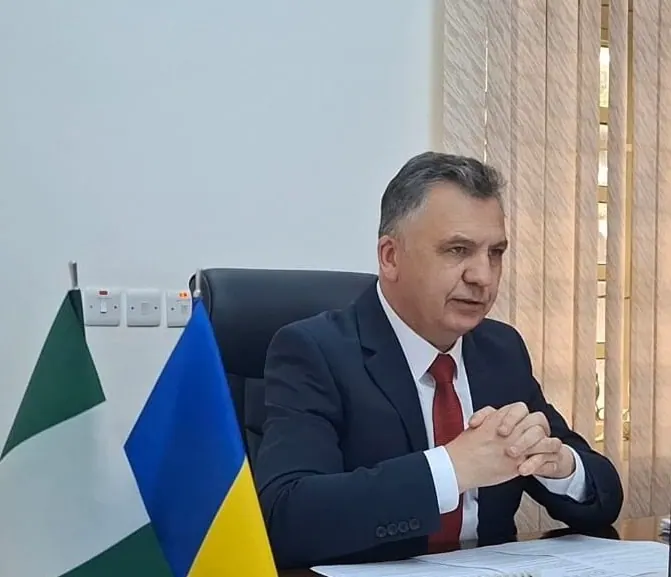
Ambassador of Ukraine to Nigeria, Ivan Kholostenko, has made an appeal for the safe return of children, civilians, and Prisoners of War (PoWs) to their families and communities amidst the ongoing Russia-Ukraine war. He highlighted a nationwide minute of silence observed in Ukraine every morning at 9 a.m. to honor those killed in the conflict. This daily ritual has become a powerful expression of remembrance for fallen soldiers and civilians.
The minute of silence is marked by loudspeakers broadcasting the steady ticking of a clock at 9 a.m., while traffic stops and people in workplaces, homes, schools, markets, and on highways pause for one minute. Kholostenko emphasized that this moment of silence honors Ukrainians who lost their lives defending the country's sovereignty and freedom, as well as civilians killed in the conflict. It also reflects the absence experienced daily by families whose loved ones have not returned home.
Kholostenko drew attention to Ukrainian children who, according to Ukrainian authorities, have been forcibly transferred or deported by Russia during the war. Many of these children have been separated from their families and communities, and in some cases, have experienced changes to aspects of their identity, including their language, culture, and names. The Ambassador raised concerns over the welfare of these children and the need for their safe return.
The Ambassador also expressed concern about Ukrainian civilians detained in territories temporarily occupied by Russia, citing allegations of persecution for teaching their language, preserving their culture, speaking against the occupation, or sharing information about events they had witnessed. Some civilians have been transferred to detention facilities in Russia, where they allegedly face restrictions on contact with relatives and access to adequate medical care.
Kholostenko further expressed concern about Ukrainian prisoners of war held in Russian captivity, citing accounts from former detainees and reports by independent organizations alleging torture, sexual violence, and other forms of abuse. He stated that these are not side effects of Russia's war but repeated and well-documented violations of international law. The Ambassador emphasized the need for sustained cooperation among governments, international organizations, humanitarian agencies, and civil society to address the humanitarian challenge.
The Ambassador referred to the Pathways to Peace: Second International Conference on Returning Ukrainian Children, Detained Civilians, and Prisoners of War, held in Toronto, Canada, on September 28–29. The conference brought together foreign ministers and international partners to advance international efforts to secure the return, rehabilitation, and reintegration of Ukrainian children, detained civilians, and prisoners of war. Kholostenko stressed that the return of those affected by the war is both a humanitarian imperative and an important component of efforts toward a peace process.
Kholostenko appreciated the support of governments, international organizations, humanitarian actors, and civil society groups working to facilitate the return of Ukrainian children, civilians, and prisoners of war. He emphasized that only through the joint and sustained efforts of the international community can they ensure the return of every deported child, every unlawfully detained civilian, and every Ukrainian prisoner of war. The Ambassador expressed gratitude to all states, international organizations, humanitarian actors, and representatives of civil society who are helping Ukraine bring its people home.
Key points
- The Ukraine Ambassador to Nigeria calls for the safe return of children, civilians, and prisoners of war affected by the Russia-Ukraine war.
- A nationwide minute of silence is observed in Ukraine every morning at 9 a.m. to honor those killed in the conflict.
- The Ambassador emphasizes the need for sustained cooperation among governments, international organizations, humanitarian agencies, and civil society to address the humanitarian challenge.