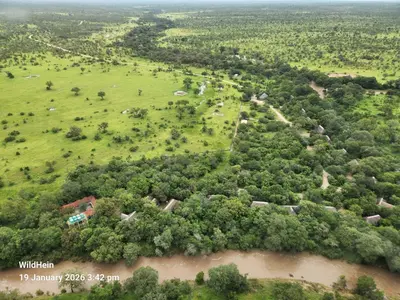
A new renewable energy deal has been announced for Kruger National Park in South Africa, which will provide the park with clean power equivalent to over a quarter of its annual electricity consumption. The agreement, between South African National Parks (SANParks) and Ampli Energy, a product of Discovery Green and Sasol, will see renewable energy generated elsewhere and delivered through the national grid to the park. This approach allows Kruger to benefit from renewable energy without having to build large-scale generation infrastructure inside the park.
The idea for the renewable energy project was first conceived two years ago by Andre Nepgen, chief executive of Discovery Green, and Dan Ginsberg, head of actuarial and R&D at Discovery Green. They envisioned a way to power the iconic conservation area with clean energy, but it wasn't until the launch of Ampli Energy in May 2025 that the project became a reality. Ampli Energy was designed to overcome the difficulties facing businesses and organisations wanting to use renewable energy, including long-term commitments and uncertainty around future electricity needs.
Kruger National Park is SANParks's largest electricity user, accounting for about 70% of the entity's emissions from purchased electricity. With over 1.8 million visitors in 2025, the park's electricity demand is growing. Building renewable-energy generation inside the park would require significant capital and land, which SANParks said was better reserved for conservation. Instead, the partners are using South Africa's evolving electricity market to wheel renewable energy through the national grid to Kruger.
The renewable energy agreement is a pioneering experiment for SANParks, which wants to protect the environment while making the most of partnerships with the private sector. SANParks manages 21 national parks covering more than four million hectares of land, but Kruger is by far its biggest electricity user. The partnership is in operation, with Discovery Green and Sasol having provided renewable energy equivalent to more than 25% of Kruger's electricity consumption for the past few months.
Sasol's role is central to the model, with the company's Secunda complex acting as the "backstop offtaker" for Ampli Energy's renewable energy portfolio. Dr Sarushen Pillay, Sasol's executive vice-president for business building, strategy and technology, said the arrangement was accelerating decarbonisation within Sasol while helping SANParks and other organisations do the same. The partnership is part of a broader effort to modernise infrastructure and improve resilience.
SANParks is under pressure to reduce its carbon emissions while managing the financial demands of running a vast conservation estate. The organisation generated about 80% of its operating budget through tourism, which helps fund its conservation mandate. The savings from the renewable energy deal will give SANParks greater flexibility to support its conservation mandate, including tackling rhino and succulent poaching and snaring, addressing challenges faced by communities, and investing in infrastructure and climate resilience.
The transition to renewable energy was also driven by past experience with load-shedding, when SANParks spent millions of rand on diesel to keep Kruger operating. SANParks chief executive Hapiloe Sello described the initiative as a pilot that could potentially be scaled up within Kruger and eventually across other national parks. The renewable energy agreement forms part of a broader effort to modernise infrastructure and improve resilience, with Sello hoping that if the initiative works well, it will be expanded to other parks.
Key points
- Kruger National Park will receive renewable energy equivalent to over 25% of its annual needs.
- The renewable energy deal is a pioneering experiment for SANParks, which wants to protect the environment while making the most of partnerships with the private sector.
- The partnership is part of a broader effort to modernise infrastructure and improve resilience.