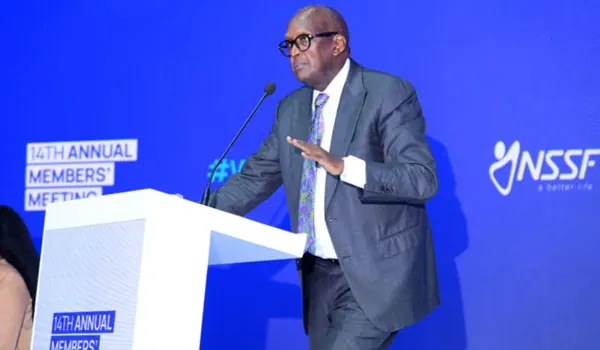
The National Social Security Fund (NSSF) in Uganda has announced a 22.53% interest rate, crediting Sh5.44 trillion to member accounts, bringing its total assets to Sh32.8 trillion. However, remarks by Lt Gen Henry Tumukunde have raised concerns about potential political interference in the fund's operations. Gen Tumukunde, a high-ranking state actor, has dismissed criticism of his tone, stating that his approach to public affairs is unchangeable at 69 years old.
The NSSF is not only a local deposit box but also an international financial player with over Sh10 trillion invested in regional equities, sovereign debt, and cross-border capital markets across Kenya, Tanzania, and Rwanda. The fund's investments have a significant impact on Uganda's economy and regional financial markets. Any perception of political interference in the fund's allocation decisions could have far-reaching consequences, including increased sovereign risk premiums and decreased investor confidence.
Gen Tumukunde's comments have sparked fears of arbitrary capital redirection, which could scare away global institutional partners and depress the prices of regional debt instruments where NSSF invests. The NSSF Board must strictly adhere to its mandate as articulated in the NSSF Act to mitigate these shocks. The Board's independence and professionalism are crucial in ensuring the fund's continued growth and stability.
The NSSF's growth from a modest scheme to a UGX 32.8 trillion powerhouse generating UGX 6.51 trillion in annual revenue is attributed to President Yoweri Kaguta Museveni's strategic stewardship. Under his leadership, legislative stability has allowed private savings to aggregate into a regional financial giant. The President has a duty to protect the fund from political interference, as it is a crowning achievement of his governance.
Ugandan workers are already heavily taxed, and converting their NSSF savings into unhedged political projects would be unfair double taxation. The NSSF savings represent deferred private consumption for old-age survival. Gen Tumukunde's concern on public investment highlights the importance of balancing nation-building with fiduciary duty. A robust social security fund acts as a catalyst for Uganda's broader economy, providing sovereign independence and reducing reliance on expensive foreign debt.
The NSSF can finance Uganda's economic transformation while safeguarding high liquid yields for its members by keeping public infrastructure allocations structured through sovereign-backed, inflation-linked bonds. This approach would allow the fund to support nation-building initiatives while protecting the interests of its members. The key lies in striking a balance between public investment and fiduciary duty.
The security of private property is the bedrock of public commerce, as observed by Adam Smith. The professionals at NSSF can honor the President's grand vision, reassure international capital markets, and safeguard the sacred sweat of Uganda's workers by maintaining the fund's independence and professionalism. The NSSF's continued growth and stability depend on its ability to navigate the challenges posed by political interference.
Key points
- The NSSF's independence is crucial in ensuring the fund's continued growth and stability.
- Political interference in the NSSF's operations could have far-reaching consequences, including increased sovereign risk premiums and decreased investor confidence.
- The NSSF can finance Uganda's economic transformation while safeguarding high liquid yields for its members by keeping public infrastructure allocations structured through sovereign-backed, inflation-linked bonds.