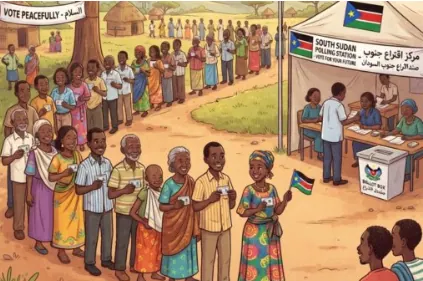
South Sudan stands at a pivotal moment in its history, with recent amendments to the National Elections Act and the dissolution of the Revitalized Transitional Government of National Unity (RTGoNU) intensifying debate about the country's future direction. The changes aim to end years of prolonged transitional governance, allowing citizens to choose leaders through elections. However, concerns linger about the readiness of the political, security, and institutional frameworks for credible elections.
The Revitalized Agreement on the Resolution of the Conflict in the Republic of South Sudan (R-ARCSS) was signed in September 2018 to provide a pathway from conflict to constitutional governance. Transitional institutions were created to implement reforms, maintain stability, and prepare the country for democratic elections. Despite this, implementation has faced repeated delays, with major provisions of the peace agreement remaining incomplete, leading to multiple extensions of the transitional period.
Supporters of the recent electoral reforms argue that continued postponements risk undermining the original purpose of the peace agreement. They believe that eventually, citizens must be allowed to confer political legitimacy through elections rather than through indefinitely renewed political arrangements. However, critics question whether the conditions for credible elections are sufficiently in place, citing concerns over security, preparedness, and public confidence.
The amended electoral law removes previous requirements linking elections to the completion of a permanent constitution and a national population census. While supporters argue that this change is necessary to prevent further delays, critics contend that it weakens important safeguards intended to strengthen electoral credibility. The central issue is whether elections can be conducted in a manner that commands broad public trust.
Critics of the dissolution express concerns over security, citing warnings from the United Nations Commission on Human Rights in South Sudan that important safeguards necessary for a peaceful and credible election remain insufficient in several areas. Additionally, voter registration had not yet commenced when the electoral amendments were adopted, presenting undeniable logistical challenges. The situation of opposition leader Riek Machar, who remains under house arrest while facing charges he denies, also raises concerns about the broader political environment.
International human rights organizations have called for protection for journalists, civil society organizations, political actors, and ordinary citizens as the electoral process unfolds. A survey commissioned by the United Nations Mission in South Sudan (UNMISS) found that over 90 percent of respondents considered elections important and intended to vote. However, respondents also identified security concerns, inadequate preparation, funding constraints, and political disagreements as obstacles that still need to be addressed.
The responsibility for ensuring credible elections lies with all political actors. Governments must provide a free and peaceful environment for citizens to participate. Electoral institutions must demonstrate professionalism, independence, and transparency, while security institutions must protect voters rather than influence them. Opposition parties must present practical alternatives, engage constructively with the electoral process, and offer voters a compelling vision for the future.
Key points
- South Sudan must balance the need to transition from a power-sharing system to one grounded in democratic accountability with concerns over the readiness of its political, security, and institutional frameworks.
- The country's recent electoral reforms aim to prevent further delays but have sparked debate over the removal of safeguards intended to strengthen electoral credibility.
- All political actors in South Sudan have a responsibility to ensure that elections are conducted in a free, peaceful, and credible manner.