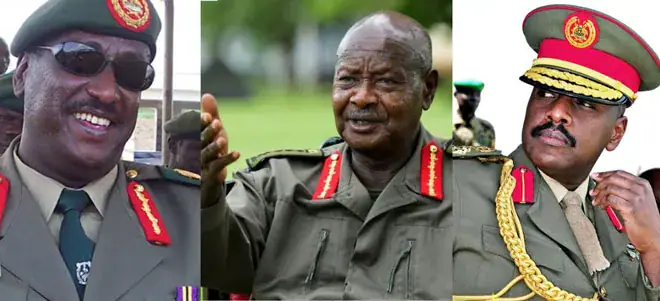
Gen. Caleb Akandwanaho, also known as Salim Saleh, and Prof. Ogenga Otunnu have proposed a "Consociational Democracy Agreement" to address Uganda's historic divisions. The proposal, outlined in a 135-page working paper, aims to establish a framework for political cooperation, reconciliation, and the gradual resolution of Uganda's historical divisions. The paper, titled "Addressing the Root Causes and Consequences of Sectarianism, Exclusion, Marginalization and Conflicts in Uganda," traces Uganda's divisions across various lines, including religious, ethnic, regional, racial, ideological, and economic.
The proposal comes at a time when President Yoweri Museveni has begun a new five-year term after winning the January 2026 election, and discussion about his succession has become increasingly prominent. Gen. Muhoozi Kainerugaba, President Museveni's son and the country's Chief of Defence Forces, has publicly indicated an intention to run for president in 2031. The question of succession is part of the political atmosphere in which Saleh and Otunnu are proposing a new national compact. Saleh's involvement in the proposal has raised questions about the potential for the Museveni family to negotiate a future beyond the current political system.
The Consociational Democracy Agreement seeks to move beyond temporary bargains among elites and instead establish a written, public, and inclusive agreement that would be integrated into government policy, budgets, and institutions. The proposal argues that political cooperation should reach ordinary citizens rather than remain confined to negotiations among party leaders. It presents consociationalism as a way of organizing cooperation in a society divided by competing interests and historical grievances.
However, the proposal's ambition has left many observers and analysts asking questions about its feasibility. One key concern is how such a framework would operate in a political system where the authority to implement its recommendations is concentrated in the same institutions and leadership structures that it seeks to influence. Policy analyst Godber Tumushabe and Democratic Party vice-president Fred Mukasa Mbidde have scrutinized the proposal, raising questions about its potential impact.
Saleh's involvement in the proposal has also raised questions about the potential for the Museveni family to shape the country's future. Saleh's engagement with Dr. Kizza Besigye, the ailing veteran opposition politician, has been seen as a significant development. Saleh visited Besigye in prison and facilitated his release for medical examination, citing a desire to reconnect with his old political adversary. This engagement has been linked to the Consociational Democracy Agreement, with Saleh suggesting that the proposal seeks to address the grievances of various communities and promote national reconciliation.
The proposal's authors argue that successive administrations have attempted forms of political cooperation and power-sharing, but these arrangements have often remained agreements among elites, offering temporary stability without adequately addressing the grievances of the communities they claimed to represent. They credit the NRM's 40-year grip on power with making the most sustained progress against sectarianism in Uganda's history, but also acknowledge the country's unresolved problems, including electoral credibility, institutional independence, and youth unemployment.
The Consociational Democracy Agreement has sparked a national conversation about Uganda's political future and the potential for a new national compact. While some have expressed skepticism about the proposal's feasibility, others see it as an opportunity for the country to address its historic divisions and promote national reconciliation. As the proposal continues to be debated, its impact on Uganda's political landscape remains to be seen.
Key points
- The proposal seeks to establish a framework for political cooperation and reconciliation in Uganda.
- The involvement of Gen. Caleb Akandwanaho and Prof. Ogenga Otunnu has raised questions about the potential for the Museveni family to shape the country's future.
- The proposal's feasibility has been questioned due to concerns about its implementation in a political system with concentrated authority.
Reporting sources
- Can the Museveni family negotiate Uganda out of the Museveni era? · The Independent magazine