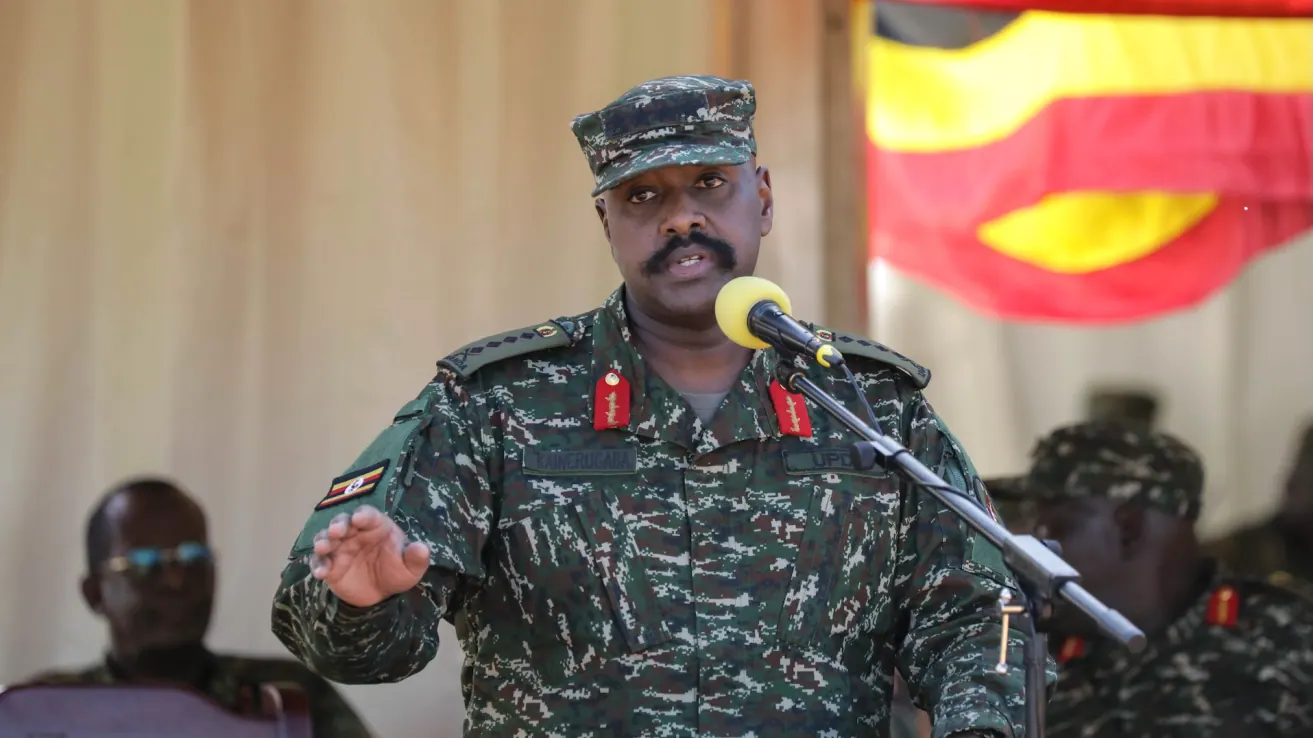
Uganda's January elections, which handed President Yoweri Museveni a seventh term, have heightened debate over his succession. The military, led by General Muhoozi Kainerugaba, Museveni's son and military chief of the Uganda Peoples' Defence Forces (UPDF), is increasingly influential in politics. This has raised concerns about the country's democratic future. Since Uganda's independence in 1962, power has never changed hands through voting, and the military has been deeply entrenched in politics.
The military's influence is institutionalized in Uganda's governance structure. The constitution designates the military as a special interest group, allocating 10 parliamentary seats to its representatives. The mixing of civilian and military authority has been a key factor in Museveni's 40-year rule. Critics argue that this has led to arbitrary arrests of government critics and military trials of political detainees and civilians. Human Rights Watch reports that at least five critics of Museveni and Muhoozi have been detained since mid-June.
Muhoozi's growing prominence in Uganda's succession politics is contrary to Ugandan law, which prohibits serving military personnel from engaging in politics. Despite this, he has positioned himself for succession, stating on social media that he wants to succeed his father as president. His prospects have been boosted by the recent formation of the Patriotic League of Uganda (PLU), a political pressure group comprising Muhoozi-aligned NRM members.
Muhoozi's declaration that PLU-aligned ministers are present in the recently appointed cabinet demonstrates his executive decision-making power. It places him in a central position to claim leadership of Uganda post-Museveni. His control of the military is also critical in the succession matrix. As UPDF head, Muhoozi previously said the army would accept only a Commander-in-Chief (national president) from the military or police – a statement that threatens Uganda's nascent democracy.
The potential for a dynastic power transfer is not limited to Muhoozi. Museveni's son-in-law Odrek Rwabwogo, a senior presidential adviser, is viewed as Muhoozi's rival. Rwabwogo has described Muhoozi as a 'drunkard and a lumpen who can never become Uganda's president.' Muhoozi retorted that Rwabwogo was Uganda's 'biggest thief,' revealing strained relations and political competition in the Museveni household.
Muhoozi's rise has arguably spelt doom for Ugandan opposition efforts to produce a post-Museveni leader. Veteran opposition leader Dr Kizza Besigye's arrest in Kenya, his rendition to Uganda's Luzira Prison, and continued detention through court martial have weakened opposition voices. Muhoozi publicly declared that Besigye would not be released, despite his deteriorating health. Besigye's wife Winnie Byanyima, a senior United Nations official, has described Besigye as Muhoozi's prisoner.
The Museveni succession now increasingly favours the NRM due to its strength in Parliament and the power of incumbency. The prominent position of the military, with Muhoozi at the helm and an institutional participation in Uganda's politics, suggests that security personnel will likely determine Uganda's future. This poses a risk to democracy and could stoke ethnic tensions. Museveni's rule is widely argued to have benefited the Banyankole in terms of positions and power, to the disadvantage of the populous Baganda, from which the popular opposition leader Bobi Wine originates.
Key points
- Muhoozi's growing influence in government and his position as military chief threaten Uganda's democracy.
- The military's institutionalized role in Uganda's governance structure has contributed to Museveni's 40-year rule.
- Muhoozi's presidential ambitions are rooted in an authoritarian vision propelled by military might.