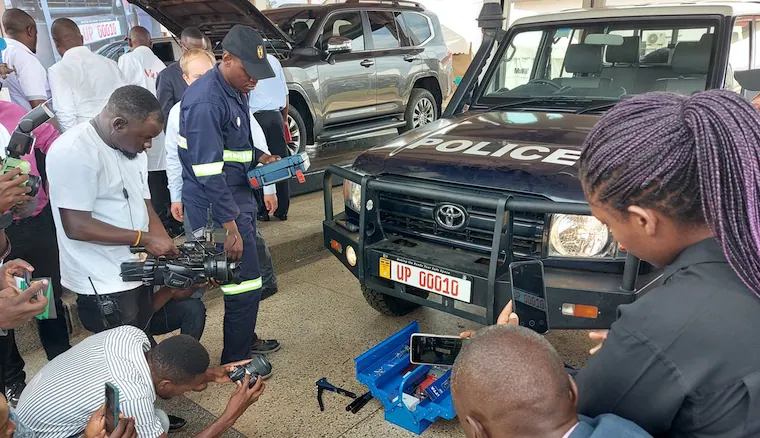
The controversy surrounding Uganda's digital number plates has sparked a heated debate about the balance between national security and citizen scrutiny. The Intelligent Transport Monitoring System (ITMS) has been touted as a solution to combat violent crime, but its implementation has raised concerns about accountability and the value for money. Motorists are paying Shs 714,300 for a digital registration plate, a significant increase from the previous cost of Shs 137,000.
The Committee chairperson, Mwine Mpaka, has clarified that the digital number plate itself does not track a vehicle, but a separate GPS tracker installed alongside it does. This distinction has sparked questions about what exactly motorists are paying for and what benefits they can expect. Former MP Abdul Katuntu has questioned the justification for the extra Shs 577,300, asking whether it is merely for the appearance of a number plate or if there are other advantages.
The government has cited the need to modernize Uganda's security infrastructure, particularly in the face of violent crime involving suspects escaping on motorcycles. Police have reported recovering 337 of 375 stolen vehicles and 174 motorcycles from 782 reported motorcycle theft cases, but it is unclear how many of these recoveries were directly attributed to ITMS trackers. Parliament must establish the effectiveness of the system and ensure that it is not merely asserted.
The financial implications of the ITMS contract are also under scrutiny. The contractor, Joint Stock Company Global Security, was expected to invest $257 million, but finance ministry figures indicate that only $115 million had been invested by July 2026. The company could collect Shs 3.3 trillion from Ugandans over the 10-year contract, raising concerns about the value for money.
Questions have also been raised about the contractor's experience and delays in delivering plates. Some motorists who expected plates within two weeks have reportedly waited up to a year. Citizens should not pay substantially more for a supposedly superior service only to receive a slower one. The delays and increased costs have sparked concerns about the accountability of the ITMS contract.
The issue of privacy is also a major concern, as technology that can locate a stolen vehicle can also reveal the movements of law-abiding citizens. Ugandans deserve to know who can access that location data, under what authority, for what purpose, and with what safeguards against abuse. The solution is not to abandon technology, but to ensure that technological ambition comes with democratic accountability.
Parliament should demand a breakdown of the Shs 714,300 charge, an independent audit of ITMS performance, and credible statistics showing recoveries directly attributable to the system. Government must also disclose the safeguards governing access to citizens' location data. National security cannot become a substitute for evidence, and Ugandans are entitled to know what they are paying for, whether it works, who profits from it, and who can use the information it generates.
Key points
- The controversy surrounding Uganda's digital number plates has sparked a heated debate about the balance between national security and citizen scrutiny.
- Parliament must establish the effectiveness of the ITMS system and ensure that it is not merely asserted.
- The government must disclose the safeguards governing access to citizens' location data to ensure democratic accountability.