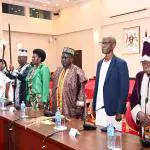
President Yoweri Kaguta Museveni recently met with traditional and cultural leaders at State House, Entebbe, to discuss cultural preservation, national unity, and socio-economic transformation. The two-day Cultural Leaders Conference brought together representatives of Uganda's traditional institutions to explore their contribution to national development. In his address, President Museveni urged traditional and cultural leaders to focus on preserving cultural heritage, promoting indigenous knowledge, and guiding their communities, while leaving legislation, public administration, and policy formulation to constitutionally established government institutions.
The President's position raises important governance questions about the relationship between cultural authority and political power. Article 246 of Uganda's Constitution recognises traditional and cultural leadership, but establishes clear limitations. Traditional or cultural leaders cannot participate in partisan politics while retaining their position, nor exercise administrative, legislative, or executive powers of government. This distinction is crucial in Uganda's governance architecture, where political authority is exercised through constitutionally established institutions, and cultural authority derives from historical identity, customary practices, and community allegiance.
The Institution of Traditional or Cultural Leaders Act, 2011, provides for restrictions on partisan political participation, making it essential for the country to understand the boundaries between prohibited partisan activity and legitimate cultural and community engagement. Cultural institutions should not become political parties in disguise, but their contribution to society should not be reduced to ceremonial functions and preserving historical traditions. A healthy relationship between cultural institutions and the government requires mutual respect, clearly defined responsibilities, and institutional independence.
Traditional institutions occupy a unique position in Uganda's governance architecture, possessing historical legitimacy, cultural influence, and grassroots relationships that political institutions do not necessarily enjoy. Cultural leaders can influence community attitudes, promote reconciliation, encourage peaceful coexistence, and mobilise people around social and economic priorities. This influence can complement government development programmes, particularly in communities where cultural institutions command considerable public trust.
The conference also discussed practical aspects of how traditional institutions could contribute to wealth creation. Cultural leaders proposed offering land for model agricultural farms, community industrialisation initiatives, skills development, cultural tourism, and the establishment of a Digital Cultural Park to document Uganda's kingdoms, chiefdoms, historical sites, artefacts, and indigenous knowledge. These proposals deserve serious consideration, as Uganda's cultural heritage represents an economic resource that can create employment, support entrepreneurship, and generate household incomes.
The country's cultural heritage can be developed to create sustainable opportunities for young people and women. Traditional knowledge in agriculture, livestock management, and indigenous occupations can be documented, modernised, and integrated into contemporary production systems. Cultural institutions can become centres for agricultural innovation, vocational training, entrepreneurship, and community-based industrialisation. The real measure of success should be the number of productive enterprises established, jobs created, skills transferred, and household incomes improved.
President Museveni also raised the issue of accountability, observing that elected leaders are answerable to voters, who can remove them from office when they fail to perform. However, accountability is not exclusively an electoral concept, as cultural institutions also have responsibilities towards the communities whose allegiance they command. The debate sparked by the conference highlights the need for a clear understanding of the boundaries between cultural authority and political power, and the importance of mutual respect and institutional independence between cultural institutions and the government.
Key points
- The conference discussed practical proposals for traditional institutions to contribute to wealth creation, including offering land for model agricultural farms and establishing a Digital Cultural Park.
- The relationship between cultural authority and political power raises important governance questions, particularly in Uganda's constitutional framework.
- Cultural institutions occupy a unique position in Uganda's governance architecture, possessing historical legitimacy, cultural influence, and grassroots relationships.
Reporting sources
- Cultural Authority, Political Power and the Question of National Development · Uganda Radio Network