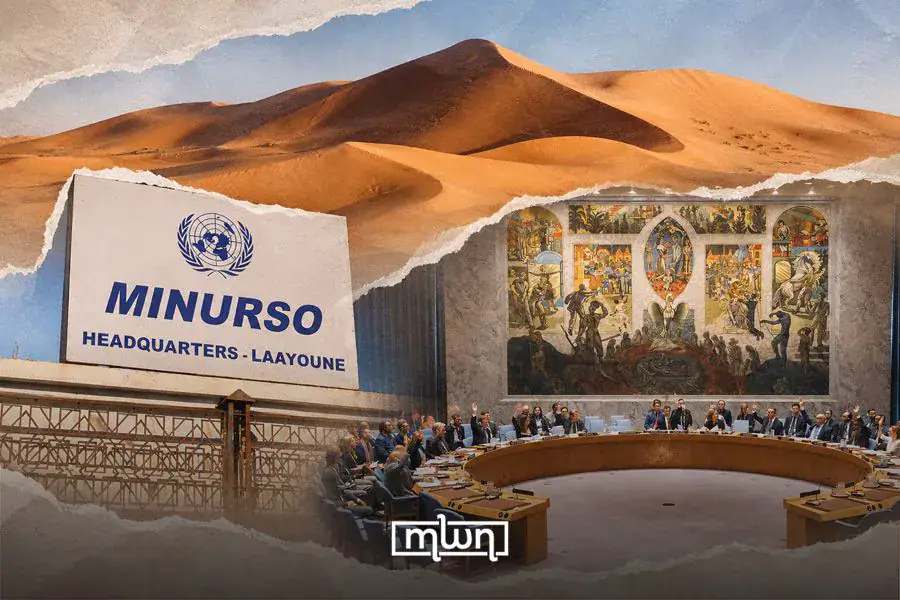
A prominent American foreign-policy publication has argued that the collapse of the United Nations peacekeeping operation in Western Sahara should be treated as an opening rather than a setback. The National Interest, a US-based journal, published an article by analysts Brett D. Schaefer and Liam Karr of the American Enterprise Institute, contending that the end of the mission could "unfreeze a peace process that has been stalled for decades." The UN Mission for the "Referendum" in Western Sahara, known as MINURSO, ended after 35 years when the Security Council could not agree to extend it.
The dispute over Western Sahara dates back to the colonial era, when Spain seized the kingdom's southern desert and severed it from Morocco. In 1973, a small separatist faction called the Polisario Front emerged, backed by neighboring Algeria. Morocco's King Hassan II launched the Green March on November 6, 1975, sending 350,000 unarmed Moroccans to reclaim the territory peacefully. The Madrid Accords were signed on November 14, 1975, handing the northern two-thirds of the territory to Morocco and the southern third to Mauritania.
The UN brokered a ceasefire and established MINURSO in 1991, pending a referendum on independence or integration with Morocco. However, the vote never took place due to a dispute over voter eligibility. Proposals by former US Secretary of State James Baker and a 2007 Moroccan plan for autonomy stalled. According to the American report, the situation on the ground has remained largely static for decades, with Morocco controlling roughly 80% of the territory and maintaining a troop presence.
The authors of the article argued that momentum has shifted toward Morocco, with Rabat's lobbying eroding support for the "Sahrawi Arab Democratic Republic" across Africa. In 2020, the US recognized Moroccan sovereignty over the territory, with President Donald Trump stating that an independent Sahrawi state was "not a realistic option." Since then, dozens of African and European countries have backed Morocco's autonomy plan and opened consulates in Moroccan Western Sahara.
In 2026, the US pressed the UN to affirm that autonomy under Moroccan sovereignty was the "only basis for negotiation" and to drop the reference to a referendum from the mission's name. Russia vetoed the US draft, and with no compromise, the Council let the mandate expire at the end of October. Morocco welcomed the outcome, while the Polisario and Algeria expressed regret.
The authors of the article maintained that continuing the mission served no useful end, describing a status quo that was expensive and self-perpetuating. US officials rejected renewing "mandates that haven't worked or cannot work," with UN Ambassador Mike Waltz calling the existing arrangement "inhumane." The US delegation has moved to engage Algerian and Polisario representatives directly.
The collapse of MINURSO has sparked mixed reactions, with some regional experts warning that the UN's departure could reignite conflict. However, the authors of the article stressed that ending MINURSO was not meant as a final step, but rather an opportunity to explore new avenues for peace. The situation remains complex, with Morocco and Algeria being rivals and the roughly 158 peacekeepers and 201 civilian staff having served as a convenient excuse to avoid hostilities.
Key points
- The US has recognized Moroccan sovereignty over Western Sahara, stating that an independent Sahrawi state is "not a realistic option."