The Uganda Law Society's Executive Order RNB No. 13 of 2026 recalls that the Defence Forces must remain non-partisan under Article 208(2) of the Constitution. However, it fails to correctly apply this principle to the Patriotic League of Uganda (PLU). The Constitution guarantees fundamental rights and freedoms, including freedom of association, which allows citizens to form and join civic organisations. Article 38 specifically protects the right to participate in peaceful activities to influence government policies through civic organisations.
The Political Parties and Organisations Act (Cap. 178) defines a political organisation as any free association whose objects include influencing the political process or sponsoring a political agenda. However, it excludes pressure groups and civic organisations from this definition. PLU's leadership describes itself as a civic organisation and pressure group operating inside the National Resistance Movement, rejecting attempts to reserve a party name. Its activities, such as endorsement registers and regional launches, mirror those of recognised civic bodies.
The Uganda Law Society's opinion appears to misapply the principles of political parties and organisations. Article 71 of the Constitution sets out principles for political parties and organisations, including national character and internal democratic governance. However, these principles only apply to bodies that operate as political parties or organisations under Article 72(2). The Constitution forbids an organisation from operating "as" a political party or organisation unless it is registered and conforms to constitutional principles.
The High Court has already declined to treat PLU's activities as criminal. In dismissing Male Mabirizi's private complaint, the Court found that support for the political ambitions of a serving officer does not, without more, render an organisation unlawful. Section 97 of the Uganda Peoples' Defence Forces Act requires a serving officer who desires to seek political office to resign first. Section 16 of Cap. 178 prohibits members of the Defence Forces from holding office in or canvassing for a political party or organisation.
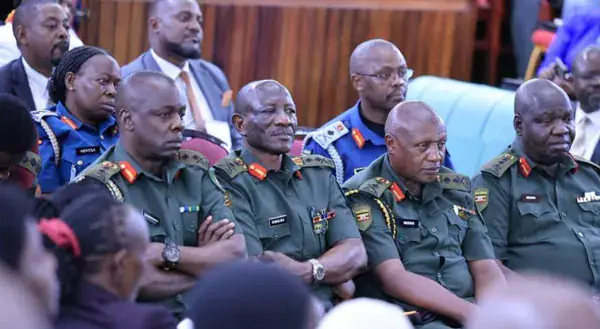
The Uganda Peoples' Defence Forces Act and the Constitution draw a distinction between formal political office-seeking and structured participation by serving officers. Article 78(1)(c) of the Constitution provides for the participation of serving officers in Parliament. Ten serving UPDF officers are elected by the Defence Forces Council and sit in Parliament while remaining in active service. This is a deliberate constitutional design that recognises the army as a special interest group entitled to representation.
Globally, organised civic groups openly support serving military officers without registering as political parties. In the United States, the Association of the United States Army (AUSA) and the American Legion support America's Army and its families. In the United Kingdom, Veterans for Britain, formed by senior officers, operates as a pressure group on defence sovereignty. These examples demonstrate that structured civic association by serving officers is not necessarily a breach of non-partisan principles.
The Uganda Law Society's opinion on PLU misapplies the constitution, statute, and comparative practice. The Constitution and laws of Uganda allow for civic association and structured participation by serving officers. The Society's opinion fails to consider the distinction between formal political office-seeking and civic association.
Key points
- The Uganda Law Society's opinion on PLU misapplies Article 208(2) of the Constitution and the Political Parties and Organisations Act.
- The Constitution guarantees freedom of association and the right to participate in peaceful activities to influence government policies through civic organisations.
- Globally, organised civic groups support serving military officers without registering as political parties.