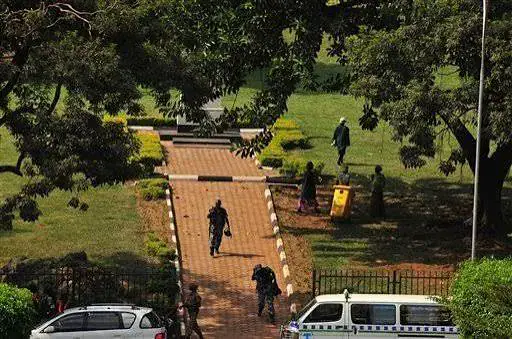
The Ugandan government has dropped plans to redevelop State Square, also known as Constitutional Square, in a decision announced by Minister for ICT and National Guidance, Kasule Lumumba, on October 27, 2026. The Cabinet, chaired by President Yoweri Kaguta Museveni, decided to retain the square's existing legal status, effectively abandoning the proposed redevelopment. This move aims to preserve the historic site, which has been protected since Uganda's independence in 1962.
The decision to preserve State Square was made after reviewing its legal protection, national heritage value, and environmental concerns. Lumumba explained that the site is not just an ordinary public space but a legally protected heritage site, recognised under the Museums and Monuments Act of 2003 and a heritage protection instrument issued in 2004. The 1995 Constitution also provides another layer of protection, identifying the area as Constitutional Square.
One of the key features of State Square is the 1945 war memorial, which honours Ugandan soldiers who died during the First and Second World Wars. The memorial stands within the protected area, covering approximately 1.172 hectares across plots 5, 6, and 7. The site's heritage value and historical significance were major factors in the Cabinet's decision to prioritise preservation over redevelopment.
The proposed redevelopment plan had sparked controversy, with opposition from Kampala Lord Mayor Ronald Balimwezo and other critics, who warned that commercial construction could deprive the city centre of valuable green space and undermine the site's historical significance. The Forum for Democratic Change had also threatened legal action if authorities attempted to transfer, lease, or sell the land for private development.
State Square has faced repeated attempts to turn it into commercial property, with previous plans triggering disputes over public land, heritage protection, and the future of one of Kampala's remaining open spaces. Originally reserved around 1903 as Government Square during British colonial rule, the land later became an important public space in Kampala's central business district.
In August 2026, businessman Hassan Bulwadda proposed turning about two acres of the site into a commercial complex featuring a hotel, shopping mall, and other facilities powered partly by solar energy. However, this plan was met with resistance, and President Museveni directed Kampala Minister Minsa Kabanda to examine the proposal in consultation with KCCA and report back.
The Cabinet's reversal brings the current proposal to an end, while leaving the square's existing legal status intact. This decision settles the government's position on the proposed project, although it is unclear whether alternative proposals for the site will be considered in the future. The site's protected status ensures its preservation for future generations, recognising its significance in Uganda's national history.
Key points
- The Ugandan government has prioritised the preservation of State Square due to its national heritage value and historical significance.
- The site's protected status, recognised under the Museums and Monuments Act of 2003, will be maintained.
- The decision brings an end to the controversy surrounding the proposed redevelopment plan.